USC Student Reps Talk Drastic Tuition Increase With CHED
The drastic increase in tuition and other fees, stagnation of teachers’ salaries, and the faulty implementation of the university’s bridging program – student representatives from the University of San Carlos (USC) raised these matters to Commission on Higher Education (CHED) Regional Director Maximo C. Aljibe at the commission’s regional office in Lahug on April 12, 2019.
A group of 29 students met with CHED to present the current situation of the university, reporting the problems in the implementation of the tuition and other fees increase – nicknamed by the administration as a “new tuition fee” – and the CHED memoranda that may be applied.
- Complete lack of notice before raising the fees
First on the agenda was the questionable rollout of the fees increase. Supreme Student Council (SSC) President Joahanna Veloso informed Aljibe that the increase came without proper consultation with the students nor prior notice to the commission. To verify the latter claim, Aljibe called Dr. Carlene dela Pena, who was once in charge of student affairs, to join the meeting. Dela Pena confirmed that she had received no written notice or letter from the USC administration.
Freshman student Megara Lim cited current CHED policies that explicitly state that Higher Education Institutions (HEI) must either publish notices of the increase in conspicuous places or inform CHED on February 28 of the year prior to the effectivity of the increase, regardless of the autonomous status of the institution. Lim emphasized that the university has not complied with either, after which Aljibe appeared to finally understand the gravity of the situation, saying “my lips are sealed.”
- No salary raises for school personnel
Next, Veloso informed the director that the teaching and non-teaching personnel of the university have reported no increase in their pay despite the increase in students’ fees. After consulting with faculty and staff, the council found and reported that they have seen no salary increase in the last 3 years.
This, Lim elaborated, runs contrary to section 7.2.2 to 7.2.4 of CHED Memorandum Order 3, Series of 2012, which specifically states that “70% of the proceeds derived from the tuition fee increase [be] used for the payment of increase in salaries, wages, allowances and other benefits of its teaching and non-teaching personnel and other staff.”
Aljibe confirmed that this provision of the memorandum properly applies to the situation.
- Increase exceeds the limit prescribed by the Philippine Statistics Authority
Aljibe mentioned that HEIs are subject to a regional “education deflator” that prescribes the maximum amount that an institution can increase by. In the case of Cebu, the limit is at 2.5%. Veloso produced figures, showing that various programs throughout the university saw a tuition fee increase that went beyond the threshold, with some exceeding by over 100%.
Aljibe explained that, in some cases, increasing by more than the deflator prescribes may be reasonable to a certain degree. In Cebu, for example, an institution may increase by as much as 10%. Dela Pena clarified that to exceed the limit would require the institution to turn in a breakdown of the increase and noted that USC has not. This, she emphasized, serves as valid grounds to forfeit the increase.
- Mandatory and paid bridging program
Veloso lastly reported that in USC, Senior High School graduates who intend to enroll in a college program that does not match their strand are required to enroll in bridging programs that each cost PHP 10,000 but have no credited units. Aljibe, after asking a number of clarificatory questions, concluded that USC’s implementation of bridging programs clearly goes against the provisions CHED memoranda. He claimed that bridging programs were required at first but are now only encouraged by the commission. The memorandum also explicitly notes that bridging programs should not pose a burden to the students.
Aljibe saw the validity of the complaints so far but asked that the students prepare and send a printed position paper elaborating on the point brought up during the meeting. These, he explained, will be responded to by a counter paper from the USC administration. When asked about what the commission can do about the situation, Aljibe established that a thorough investigation of the matter needs to precede any action.
As for the possible sanctions that may be imposed if USC is found to indeed have infractions, he cited CHED Memorandum Order 3, Article VI, Section 14, which states that if an institution is found to be in violation of the regulations in the memorandum, the CHED Regional Office with purview over the institution may not only cancel its application for fees increase. Other penalties that the commission may impose include “revocation of permits” and “downgrading of status [referring to autonomy].”
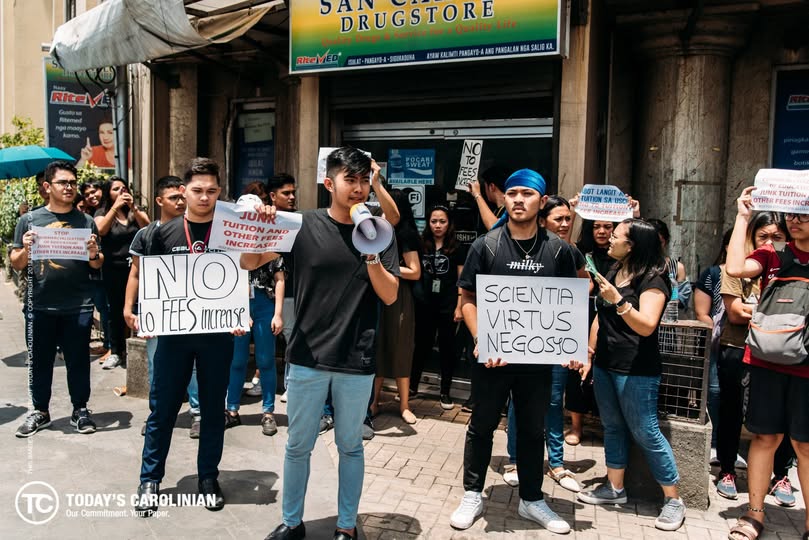
Rise For Education Alliance – USC, a nonpartisan collective of organization representatives and individual students opposing the fees increase founded by Lim, has since released a statement on the issue and intends to continue the struggle to junk the fees increase. This includes a print and online signature campaign towards this end.