A Matter of Principle: The Modern Diorama of the Free Press
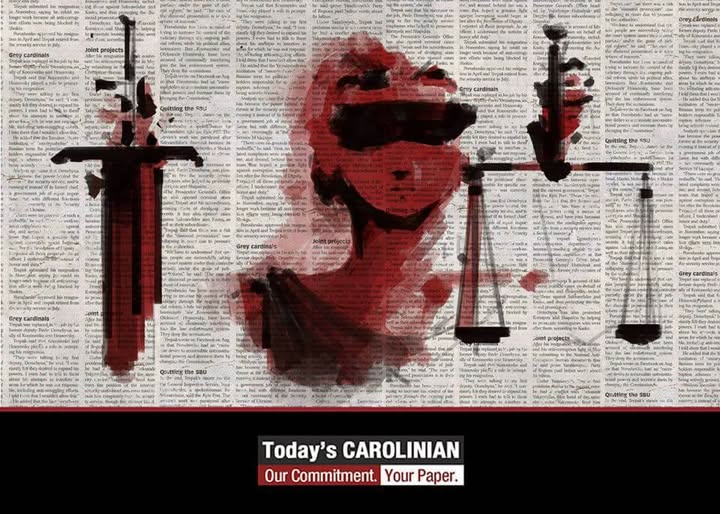
Illustration by Eduard Jude Jamolin. For reference is this article: /with-passion-and-hard-work/
“It is the press, above all, which wages a positively fanatical and slanderous struggle, tearing down everything which can be regarded as a support of national independence, cultural elevation, and the economic independence of the nation.”
― Adolf Hitler, Mein Kampf
Following a decade of intimidation, censorship, and imprisonment brought about by the region’s shift to democracy after the Cold War, African journalists put forth their collective suffering in the hands of unsuppressed power in what the world will later regard as the beacon of press freedom.
With the theme “Promoting an Independent and Pluralistic African Press”, the 1991 UNESCO seminar held at Windhoek, Namibia bore witness to the declaration of the freedom of the press, tailored by journalists in the region as a statement against the various repressions on journalism at the time. They had had enough, and the Windhoek Declaration, as it would later be called, was the line they drew with their blood.
Pivotal to the spread of the idea of a “free press” throughout the world, the Windhoek Declaration, a document bearing the principles vital for the production of a free, independent, and pluralistic media, was credited as the first of its kind. Many were inspired with the boldness of the declaration and, seeing justice within its bearings, followed suit. As such, the anniversary of the declaration, May 3, has since been declared by the United Nations as World Press Freedom Day.
But what exactly do we mean by freedom of the press, and more importantly, why is there a need to celebrate it?
According to George Orwell, the freedom of the press is simply the freedom to oppose and criticize. This is the crux of its definition. The press, in essence, represents the collective consciousness of the people a government serves. It is for, and because of, freedom that it exists. Viewed from our constitutional vantage point, the freedom of the press is the guardian of the check and balance between the three branches of our government. A “free press”, in this sense, directly equates to a free people.
Put into context, however, the lofty ideologies mentioned above fail to hold on most occasions. This isn’t necessarily because of external pressures, such as the repression and injustice experienced by African journalists in the Windhoek Declaration. More often than not, the failure to uphold the ideals of a “free press” lies within the internal structure of media companies themselves.
As with everything else, this issue of dissonance boils down inevitably to economics.
Editors, writers, photographers, broadcasters, paper, transportation, office utilities – all of these are vital for a functioning media company, but all of them have a cost. As mentioned, the primary reason why the “free press” often fails to be free is because maintaining it requires a significant amount of money, an amount that can only be filled by either the subscribers or, more practically, the advertisers. In rare cases, donations may supplement the amount. This dependence on external influence for the conduct of its most basic operations significantly impairs the freedom of a media company.
However, as stated in his article “Islands of Integrity in Asian Media Show Why World Press Freedom Day Still Matters” in the South China Morning Post, Cherian George elaborated on the practices of 12 media companies across the region that have retained their journalistic principles by virtue of unique marketing and organizational set-ups.
One such company is the Philippines’ Rappler. Though under fire at present, George acknowledges the company’s absolute policy of separation between its marketing and editorial staff. This enables them to focus solely on their specializations and, more importantly, mitigate the influence of its corporal benefactors on the decisions and content put forth by its editors.
Another such company is Indonesia’s Tempo magazine, which has retained its impressive tradition of forbidding its senior-most editors to precede its daily editorial meetings. The responsibility, instead, is divided among more than 30 junior editors in a rotational manner. This set-up, according to the magazine, is grounded on two premises. First, it is a practice of democratic decision making. If decisions were to be made strictly for the interest of the magazine, then rank should not come in play. Second, it is understood that the top editors will be the individuals most likely to be approached and influenced by powerful external entities, so disqualifying them from daily decision-making eliminates that possibility.
As mentioned above, marriage between marketing proficiency and upholding journalistic principles, a union between profit and identity, is therefore possible. It takes only ingenuity and commitment from the part of the companies themselves to do so.
On the matter of why we should celebrate World Press Freedom Day – in a nutshell, celebrations birth traditions and the world right now, with its precarious sociopolitical climate, is in dire need of the tradition of absolute respect — not for the media company itself, but for what they embody, and what they represent.
We celebrate this day because we are free and because as reflected from the quote at the beginning of this article, we recognize the fault in the statement of one of the world’s most infamous leaders — and we recognize the disaster that comes after if we don’t.