M. Butterfly: A Review
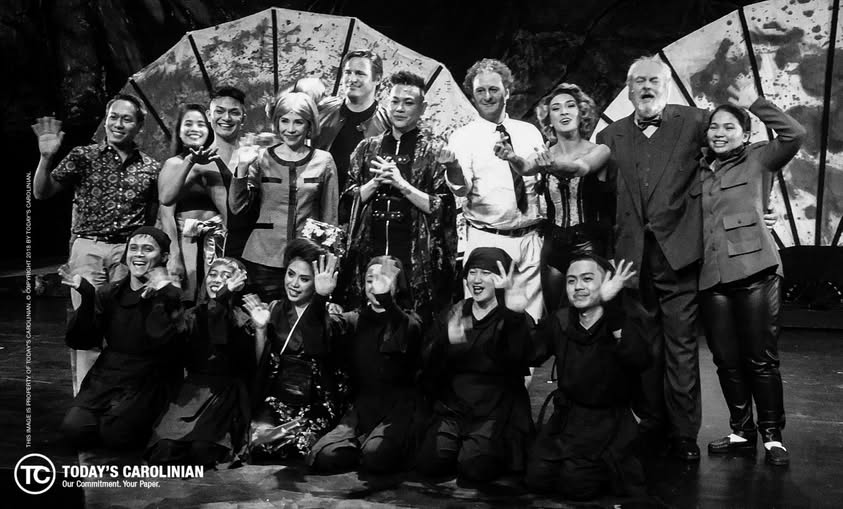
Photo by Paolo Perez
Note: M. Butterfly contains scenes of male and female frontal nudity, and as such may not be suitable for young audiences.
The Cebu leg of M. Butterfly’s Philippine tour will run from Mar. 14-17, 2019 at SM Seaside City. Produced by Tony and Grammy Award winner Jhett Tolentino in partnership with Frontrow Entertainment and directed by Kanakan Balintagos, M. Butterfly is a delightful, unapologetic delve into espionage, delusion and fantasy that stars RS Francisco and Aira Igarta as the titular M. Butterfly and Olivier Borten as the awkward French envoy René Gallimard. The cast is rounded out by Jenine Desidero as Gallimard’s wife Helga, Norman McLeod as Gallimard’s superior Manuel Toulon, Lee O’Brian as Gallimard’s best friend Marc, Mayen Estanero as regime officer Comrade Chin, Maya Encila as Renee, Gallimard’s other mistress, and Jasmin Salvo as an opera singer.
To begin understanding M. Butterfly, some context is necessary. This is not a production of Madame Butterfly, the Giacomo Puccini opera that spawned Miss Saigon, but a play written by David Henry Hwang. Premiering on Broadway in 1988 and winning the Tony Award for Best Play, M. Butterfly does not adapt the original opera as Miss Saigon does, but uses it as a plot catalyst in a tryst based on the real-life affair of Bernard Boursicot and Shi Pei Pu. Although Jasmin Salvo’s operatic vocals are powerful and impressive, helping set the ambience for several key scenes, make no mistake: this is not a musical.
Rather, M. Butterfly is largely a deconstruction of Western standards of beauty and the feminine ideal, with particular attention in how they are applied, or forced, onto Asian women. Gallimard, projects the cultivated image of Madame Butterfly onto the actor Song Liling, M. Butterfly does what its cousins Madame Butterfly and Miss Saigon do not: attack head-on the fetishization of East Asian women. Gallimard’s ideal is the meek woman, the quintessential Oriental, and his desperation to sustain that fantasy is preyed upon by Song to further his own agenda: procuring information and documents as a spy for China.
Gender becomes a performance in M. Butterfly. In the timeframe of the play, the 1960s until 1988, Song Liling — a male opera singer performing female roles — is never explicitly referred to by any of the terms under the modern banner of the LGBTQ. He is an actor, first and foremost, and his posing as a woman in what modern audiences might call a drawn-out drag performance is treated primarily as a means to an end. While this serves a thematic purpose in allowing the audience to foster their own interpretation of the character and his motive, it is also a reminder of the time and circumstance the story finds itself in, where words such as transgender were next to nonexistent, let alone accepted or widespread.
All of these considerations make M. Butterfly a joy to watch and an even bigger one to analyze, especially as the script interplays with the performances and set design. In bringing the show to a Cebuano audience, Tolentino was adamant that every aspect of the production be on par with one staged in Manila or internationally. Hwang’s script, loaded with innuendo, dark comedy and deep, striking themes that continue to resonate well after the show ends, is brought to life by Francisco, Borten and the charming, memorable supporting cast.
“The play was written over 30 years ago. The incident happened in the 60s, so you’ve got all that history,” Borten said when asked about the considerations of portraying a character so deeply ingrained with a mindset of racism and misogyny. “There were terrible racial injustices and sexual injustices. It’s taken nearly 60 years to get to where we are today.”
“It was a conscious effort for us to make it more millennial-friendly. We knew how shocking, at the time, the play was,” Francisco said, “and I still know that the play is still shocking to the millennials granted that it is based on a true story.” He describes his character as “one big fake news”, just one way the messages of a play written in 1988 continue to echo into the modern day.
Maya Encila, who pulls double duty as a pinup girl and René’s Danish mistress Renee, spoke about playing characters who are sexually liberated and upfront. “It’s funny because my character is kind of a paradox. The pinup girl is very okay with being objectified, but Renee breaks that stereotype. Like yes, she’s comfortable in her skin, she’s okay with stripping, she’s okay with having casual sex —” qualities that both fascinate and ultimately repulse Gallimard — “but she’s also okay with speaking about the flaws of the patriarchy.”. It’s this duality, this simultaneous betrayal of pretention and perversion, that enhance M. Butterfly’s commentary on the toxic masculinity that continues to rear its head well into the modern era.
With renewed interest in theatre on the rise, M. Butterfly provides a fresh take on a story many are familiar with and an invigorating change of format: as a straight play, the lack of musical numbers provides no barrier between the audience and the raw, powerful emotion.
M. Butterfly runs until Mar. 17 at SM Seaside City Cebu. All ticket proceeds will go to the Arts Council of Cebu Foundation and Children of Cebu Foundation.