Rock Pillar of the Pridelands: SAS Week 2019
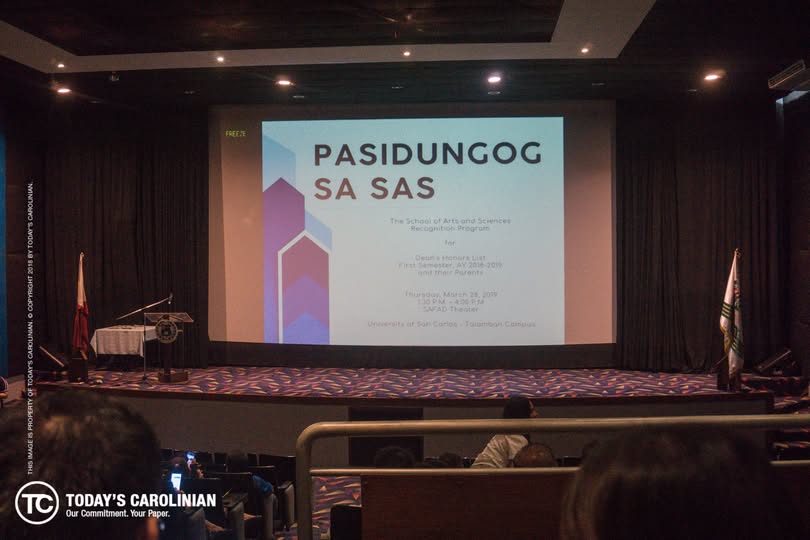
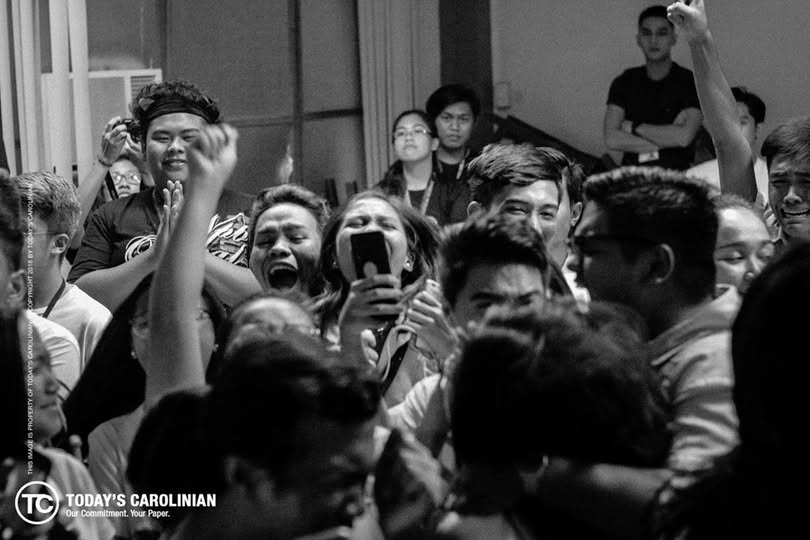
Photo by Rey Caracena
Parade and Sadsad sa SAS
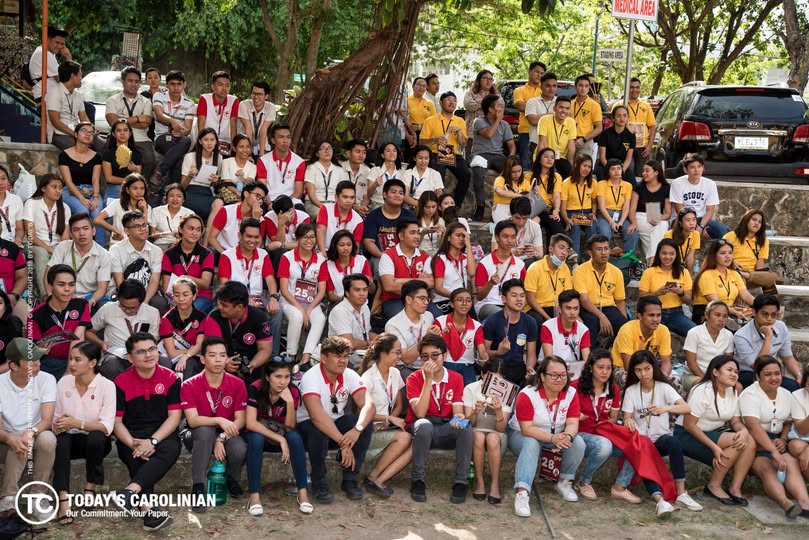
The University of San Carlos’ (USC) School of Arts and Sciences (SAS) held a series of activities to showcase the pride and spirit of the SAS students at the Talamban Campus (TC) by holding its yearly “SAS Days 2019”, which is a week-long event from March 25 to 30, 2019. The week began with a grand parade walk in the morning of March 25. The department chairs, faculty and students from different departments, together with the SAS Council who hosted the week-long event, and the Dean of SAS, Dr. Delia B. Belleza, Ph.D, joined the walk, which started at the St. Arnold Janssen Church and ended at the basketball court of TC. Following the walk was “Sadsad sa SAS,” a dance competition wherein three groups of students from Departments of Communications Language and Literature (DCLL), Psychology, Computer and Information Science (DCIS), and Physics competed. The entries included CLIQUE, who won first prize, and The Hustlers, who came in third, having both presented a hip-hop dance. While the third entry, Kaamulan claimed second, having presented a dance with a touch of tribal identity. Following the performances of the competitors was an intermission number by SAS Royale, as well as the SAS Glee who serenaded the audience. To conclude the day’s event, Fiela Joyce Legua, vice-president of the SAS Council then gave the closing remarks.
Game of Tomes
On the second day of SAS Week, DCLL held its trivia game “Game of Tomes” at the Audio Visual Room (AVR) of Philip van Engelen (PE) Building on March 26. The trivia consisted of questions about different fields of pop culture, ranging from movies to books to music.
The team representing philosophy won the championship title. Meanwhile, a spelling bee round was made to break the tie between three teams representing DCLL, which resulted in the team representing literature taking second place, while the team representing linguistics took third place.
First GenEd and Mission Symposium
Meanwhile, the First General Education and Mission Symposium was conducted by the Department of General Education and Mission (DGEM). The symposium further improved and developed the general education curriculum for the incoming freshmen. The event was held from 9 a.m. to 3 p.m. at Rigney Hall with the theme: Crafting GenEd Free Elective Mechanics and Stranding PUREMACS and Mission.”
The program commenced with welcome remarks from the Vice President of Academic Affairs, Fr. Aleksander Gaut, SVD, PhD. He articulated that free elective courses have three critical objectives. The first is to further enhance the academic undertakings of the respective areas of specialization of students. The second is to strive to become multidisciplinary and holistic. While the last, it to appropriately deliver to the students through effective mechanics and processes.
Dr. Belleza, gave a brief talk on the state of DGEM. She emphasized that free elective courses are meant to add perspectives beyond the academic disciplines and borders of students. Meanwhile, the rationale of the symposium was given by Dr. Elizabeth M. Remedio, the Chair of DGEM. She explained that structuring a good general education curriculum is always a learning experience and allows to constantly fix loose ends. “We can only hope for a smooth and easy transition during this adjustment period,” said Dr. Remedio.
The first workshop was centered on formulating and drafting GenEd free elective course titles, course description, course code, and team selection. The deliverables of the workshop include a matrix on intended learning outcomes, teaching learning activities, task assessment, proposed reference materials and prospective teachers of the corresponding free elective courses where the proposed courses must also be responsive to the 17 Sustainable Development Goals.
The second workshop was a discussion on GenEd Free Elective Mechanics presented by Engr. Ferolin, PhD. The aim of course programming was to draft 100 course titles with 30-50 authors in a team of two to four teachers for each title. Likewise, course population was to be determined through the average number of teachers per proposed free elective course. Course ownership was to be determined through faculty availability, campus or location, schedule, and the like. The event concluded with the closing remarks given by Grace Magalzo-Bualat, MPS.
SAS Debate Open
Throughout the second and third day, the SAS Debate Open was held in the AVR of PE Building in USC-TC. Organized by SAS Council, the aim of the event was to formally engage students on different issues ranging from gender and education to politics and media. Representatives competing were from DCLL, SOPHIA Organization, Department of Anthropology, Sociology and History (DASH) and Chemistry Students’ Association (ChemSA).
After three grueling preliminary rounds, the grand finals motion: “This House Will Sanction All Educational Institutions That Don’t Allow Students to Express Their Own Identity Through Clothing” was debated between the DCLL as the affirmative and the ChemSA as the opposition. Brentt Leyco, Alexis Marie Villamon and Joshua Dy Ajoc of ChemSA won the tournament with Leyco being awarded as the tournament’s Best Speaker. On the other hand, Brynch Bonachita of DASH was awarded as the Best Adjudicator.
“It was a challenging tournament, especially when the difficult motions come [sic] up,” Leyco said in an interview, “but as I felt it was really challenging and difficult, […] I really had fun for the whole duration of the tournament.” He hopes that in the next debate to come there will be more participants, interesting motions and more engaging and exciting debates.
The debate format — Asian Parliamentary — consists of a team composed of three members who will compete against other teams in a round. After judging and rating the debate, the winning team is decided by the adjudication core and competing adjudicators. Meanwhile, competing adjudicators are mainly rated by the adjudication core.
According to Bryl Lim, the main proponent of the event, he wants to have another debate tournament in the next SAS Week, assuring that it will be better than this year’s competition.
SAS Academic Forum
On March 27, the academic forum featuring Arts and Sciences as the Pillar of a University took hold at the School of Architecture, Fine Arts, and Design (SAFAD) Theater in TC. Dr. Belleza delivered her opening remarks and introduced the guest speaker for the event while Dr. Resil Mojares of Professor Emeritus, National Artist for Literature, articulated the current state of the education system that the university upholds. The talk highlighted the marketization of education, the globalization in the education system that battles for curricular space and the need to quickly produce professionals in different fields to cope with the globalizing economy. A profound change that has also been discussed is the K-12 Curriculum which promises positive and far-reaching future but remains to be a challenge as of now. Further, Dr. Mojares discussed about a more advanced liberal education, selectiveness and initiatives taken in design and enhancement of programs in the university that also creates meaningful changes which occur in classrooms. He stated, “strong liberal education must be defended and should always remain [as] education’s foundation.”
Questions from the audience were then entertained and answered by Mojares, this includes globalism in education, and the rise of technology as to how it affects education and what actions should be taken with this. A concern was raised regarding how the institution would be affected if SAS would merge with other schools within the university.. The event was then concluded by Dr. Belleza presenting a token and plaque of recognition to Dr. Mojares.
Inter-school Quiz Bowl
Following the academic forum was a quiz bowl organized by DASH called “The Great Quiz”, which took place at Fr. Harold Rigney Hall on March 27. The quiz bowl consisted of questions about general information, geography, Southeast Asian history, entertainment, sports, arts and literature. The contestants that competed for the quiz bowl were pairs of high school students from San Isidro Parish School (SIPS), Benedicto College, Patronage Of Mary Development School (PMDS), and the North and South campuses of USC (USC-NC and USC-SC).
USC-SC was crowned the winner of the quiz bowl contest with a total of 48 points. SIPS took the second place position with a total of 42 points while Benedicto College took the third place position with a total of 41 points.
I. Zazu Says
Another quiz bowl concurrently took place for the students of SAS called “Zazu Says”, where representatives from DCLL DCIS, Department of Philosophy, Department of Chemistry, Department of Psychology, and the Department of Mathematics gathered at the SAS Open Theater to participate in the quiz bowl. The questions were about USC and Integrated School Management Information System (ISMIS). In 3rd place was the Department of Psychology, 2nd place for the Department of Mathematics, and in 1st place was the Department of Chemistry.
II. Rudolf Rahmann Lecture Series
On March 28, the fourth day of SAS Week, DASH, in collaboration with the Philippine Sociological Society, hosted “Pagpakabana: Perspectives on Philippine Elections”, a seminar about the Philippine elections from the sociological perspective at the SAFAD Theater. The seminar is part of DASH’s semestral Rudolf Rahman Lecture Series.
As the first speaker, Atty. Ferdinand Gujide, an election officer of Commision on Elections and a Carolinian alumni of Political Science, stressed the importance of citizens exercising their right to vote during the election season.
Following Atty. Gujide was Manuel Victor J. Sapitula, an associate professor of Department of Sociology from University of the Philippines – Diliman, in which he discussed how one’s religious beliefs influences their decisions on the ballot during the election. He specifically presented how pastoral letters published during election season would encourage its Catholic followers to vote as it’s morally right to do so, while simultaneously not endorsing specific candidates, while the followers of Iglesia ni Cristo and the church of El Shaddai would vote for the candidates that their leaders endorsed.
Grace Magalzo Bualat of Cebu-Citizens Involvement and Maturation for Peoples Empowerment and Liberation was brought in as a reactor of the seminar, which she said that she learned a lot from Saptitula’s talk. Bualat said that religion must provide good citizens and that churches should be agents of change in order to promote the common good.
III. Pasidungog sa SAS
Following the “Pagpakabana” seminar was “Pasidungog Sa SAS”, a recognition program that commemorated the SAS students that were enlisted in the Dean’s List for the first semester of the 2018-2019 academic school year. The program was held at the SAFAD Theater on March 28. In her opening remarks, Dr. Belleza said that students should not be defined by the awards they receive but by the learnings they acquired in class . She also said that the current dean’s listers should not feel discouraged if they’re not enlisted in the Dean’s List for the second semester as there is still time to catch-up.
IV. Abilidaray sa SAS
The SAS week culminated in a music and arts festival organized by the SAS Council held at the basketball court of USC-TC. The SAS Abilidaray featured an exceptional lineup of local talents and musicians that serenaded the audience of students from the School of Arts and Sciences. The event was dotted with spoken word numbers from Almost Poets Society and a representative from DCLL. Other than a performance from the SAS Glee, a handful of dance groups and solo acts also heated up the event including Synergy, SAS Royale, the USC Dance Club, and Jandall Go. Talented musical acts were also part of the lineup. These included Andrea Badinas, Cash, Jude Pastor, Dox, and Diane Tungol and J Russ. The event concluded with live performances from Route 83 and Wonggoys. Throughout the event, the SAS council also handed out raffle prizes to participants from the audience.
V. Psychology Consultation Activity
On March 30, the final day of SAS Week, a psychology consultation activity, consultative meeting with stakeholders on the Continuing Professional Development (CPD) law and career progression scheme, was held at USC-TC Rigney Hall. The chair of Psychology department, Glenn Glarino welcomed the psychometrician and psychologist attendees, and introduced the guest and facilitator speaker, Dr. Miriam Cue. The USC president, Fr. Dionisio Miranda was also present in the event. Dr. Cue of the Professional Regulatory Board of Psychology and Professional Regulation Commission (PRC) presented a talk: Building a Culture of Competence. She discussed about the CPD law, what it meant to the professionals in the field, and how they are not affected with this new law. The new CPD law which was initiated by then Miriam Defensor Santiago, strengthens global competitiveness, improves quality of services and the country as a whole, Antonio Trillanes pushed this through after Santiago’s passing. There were oppositions and problems towards the new law such as the indefinite number of units needed to be taken, and the factors that needed to be considered. Dr. Cue also discussed about the importance of CPD which lets the professionals in the field be relevant, and up-to-date with changing trends, maintaining and enhancing knowledge and skills, and also keeping up with the current standards. The major goal of CPD in PRC perspective is that it ensures professionals to attain levels needed to fulfill requirements of ASEAN qualifications reference framework which was also discussed upon. The ASEAN framework agreement on services, mutual recognition of professional qualifications, career progression assessment, planning CPD, and universal declaration of core competencies in professional psychology were the topics articulated during the talk. The regulations, compliance, guidelines as well as psychology services in the country were discussed upon. Later on, an open forum, questions from the participants were then heard and answered by Dr. Cue.
VI. A Pedagogical Strategy for Living
Concurrently, the Department of Philosophy held a lecture-forum with esteemed guest speaker and professor of philosophy, Santiago Sia, at the AVR of PE Building. The first lecture tackled a pedagogical strategy for living guided by the EPIC trek of being evoked, provoked, invoked, and convoked. The second lecture on God and process philosophy covered discussions on the different concepts of God. Both graduate and undergraduate students in attendance were also given the opportunity to raise questions on the lecture. The event concluded with the handing of certificates to the guest speaker and to students who attended.