When the World Burns
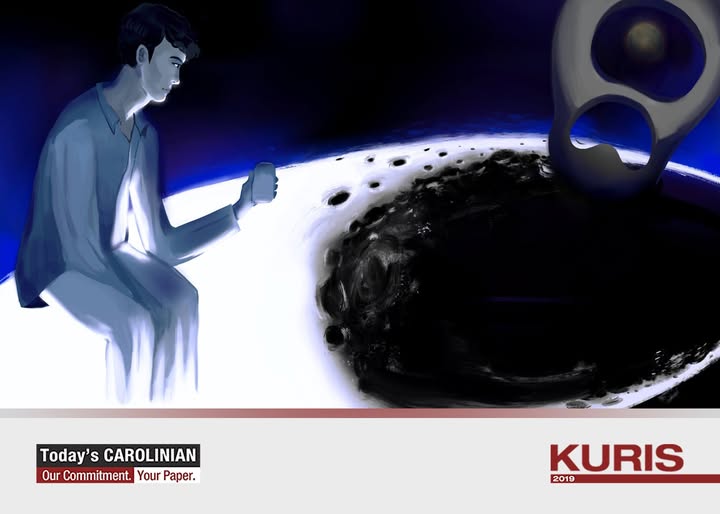
Illustration by Phoemela Delos Santos
Some men just want to watch the world burn.
I wasn’t one of them, however. And yet, as I stood there watching the tiny flashes in the darkness, I had to admit: It looked kind of pretty. I suppose that was just my way of coping with the fact that I was watching everyone I had ever known or loved die, but watching the pin-prick fireballs that signaled the end of civilization as we knew it was like watching a meteor shower. There was a certain serenity in knowing that however violent the explosions might be up close and personal, you were viewing them from a long, long way away. It’s amazing how quickly you start thinking of Earth as just another dot in the night sky, once you’re far away from it. The fiery apocalypse presently engulfing my planet was just another celestial event, like a solar storm or a star collapsing. Interesting in the academic sense, and awe-inspiring, but not personal when you get right down to it. Just another cosmic fireworks display.
We’d only been on the moon for three months. Not such a long time now that I think about it, but long enough for us to get into a routine. To get settled. To stop thinking of Earth as ‘the’ planet and start thinking of it as ‘a’ planet. The end goal was Mars of course, but before we could do that, a test colony needed to placed to ensure that humans would be able to sustain themselves for an extended amount of time in the void.
Hence our mission on the moon: not just to go boldly where many had gone before, but to boldly stay as well.
On the plus side, the mission was a resounding success. Our team landed fine and set up our base without any problem. Every part of the module was so obsessively over-designed that there was scarcely anything for us to do. Then it was just a matter of sitting back and waiting until our year-long mission had completed and we could return home. We had no scientific duties to speak of. The moon had been visited countless times before and there was no point in us trying to replicate or repeat the other people’s experiments. Our task was simply to be there and survive.
Maybe it was us simply being there that did it. There had been tension between the world powers when we left. Tension, yes, but how do people put it after a suicide? He talked about it but we never thought he’d actually do it. Maybe we were the ones who tipped the world over the edge. People were getting very heated over the new space race. Words like “interplanetary imperialism” and “weaponizations in space” were being thrown around. Of course, everyone knew that NASA were strictly idealists, but looking back on it, it’s not hard to see how “moon base” could be twisted as a “military base stationed on the moon.” And everyone knew that the moon base was the first step. Maybe, when it started looking like our mission would be going well and there would be more steps after that, someone jumped the gun to the final step.
Maybe it would have happened anyway. Guess we’ll never know now.
Communications with Earth went dead two days before it happened, which we tried very hard to explain away as equipment malfunctions at the time. I’m sure the men and women at mission control weren’t telling us everything before that. A lot of planning for this mission had centered around the fact that we were expected to go crazy at any second up here. Ridiculous thought of course – the first sailors to cross the Atlantic had been far more isolated and far less comfortable than we were. But NASA was a worst-case-scenario kind of place, and the psychologists had to have something to keep them occupied. So they were always reticent about giving us bad news. In any case, we would never find out what it was that lit that final fuse.
Everyone was down for a few days after, of course. It was only natural. But no one went crazy, at least permanently. The expected freak-outs happened and then died out in favor of a more solemn acceptance. Maybe it’s human nature to get over things you can’t do anything about more quickly. Then again, we’d all been selected for this mission in the first place since we didn’t have any close ties on Earth, and because we weren’t the most emotionally demonstrative type. What was important is that we didn’t let hysteria control us.
If this all sounds boring, then I’m afraid I’m going to have to disappoint you further. Cut off from our home world on an isolated outpost with no possibility of incoming supplies, we did not, in fact, descend into a violent orgy of murder and cannibalism. We did not start stoically drawing lots to see who would be sacrificed so that other may live. We did not meet the apocalypse and our own impending doom with religious fervor and fanaticism.
Instead, we persevered. For we were far from doomed. As was said before, NASA loved to over-engineer its equipment. Although our mission was slated to last a year, our new home and all its extensive recycling capabilities and facilities, could last for over a decade if treated properly. We also still have our lander with us, and can return to the ruins of Earth anytime we so desire. Of course we won’t be doing it right away, with the state our home planet being the over radiated rock it is. But some satellites are still functioning in orbit. We can track fallout patterns with them. Hotspots where the bombs have actually hit will be radioactive for centuries, if not millennia, but whole swaths of continents have been left barely touched by the falling bombs. We can rebuild. It may take a long, long time, but eventually humanity will be able to make its comeback for better or worse.
In the meantime, all we can do is knuckle down and crack open a cold beer on Luna. We’ll watch from up here, for a sign. We’ll watch the world burn, and when it is naught but ash, we will rebuild.