M. Butterfly – Performance Of A Performance Of A Performance
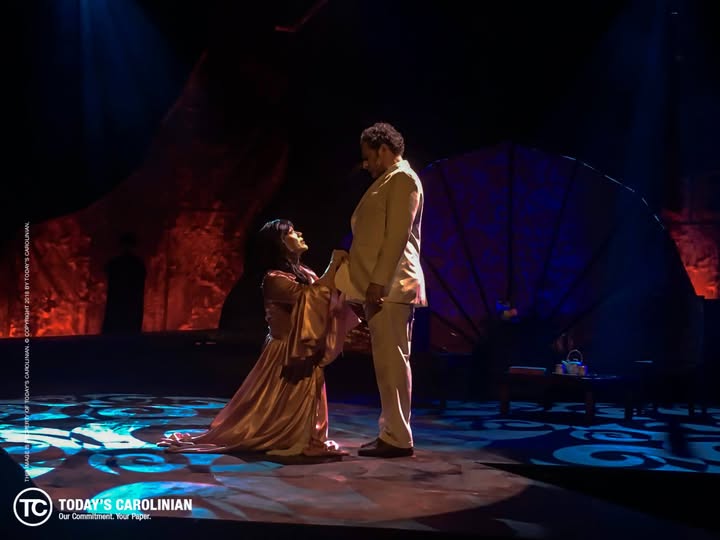
Photo by Berns Mitra
“We act as if that being of a man or that being of a woman is actually an internal reality or something that’s simply true about us – fact about us. Actually, it’s a phenomenon that’s being produced all the time and being reproduced all the time. So, to say gender is performative is to say that nobody really is a gender from the start.”
This discussion point, words of the American Philosopher Judith Butler, is pronouncedly relevant as trans women have taken center stage in public discussion and appears to be picked up by the production M. Butterfly.
In the play, not to be confused with Puccini’s Madame Butterfly that laid the foundation for the better-known Miss Saigon, a male Chinese spy by the name of Song Liling performs as a female opera singer nicknamed “Butterfly” to get the affection of Frenchman Rene Gallimard – all in an elaborate ploy to take from him intelligence crucial to the Vietnam War. Gallimard remains completely enthralled by the Chinese woman who he engages in nighttime intimacy with for over 20 years, suspiciously never once noticing his lover’s non-female genitals.
After two acts of presenting as a female, Song “transforms” into a male onstage, removing his makeup, wig, and kimono replaced with stereotypical Punk male attire. It’s easy to conclude that Song becomes and embodies genders throughout the course of the play, applying his body into the aesthetic, behavioral, and even ideological molds of “male” and “female” created by the cultural nuances of time (the Cultural Revolution) and place (China and France). However, by fluidly transitioning between presentations of gender that overlap on occasion, Song only further shoves notions of gender further into a mental space.
To restate that in English: Song Liling changes his attire, behavior, and even his beliefs to become the genders he performs. In doing so, he exposes – literally – the fact that gender only exists in the minds of both the person being a gender and the people that person comes in contact with. Song is only able to do this because he is fully aware that the concepts of gender are disembodied – a premise he subtly argues with “What passes as a woman in Modern China?”
This performance becomes so potent that Gallimard continues to believe that “Butterfly” exists long after he has seen Song’s genitals. This compels the Frenchman to insistently demand that Song resumes his female performance, proving that he had constructed Butterfly in his mind much in the same way he would mentally and socially construct any other woman.
The simulation of and commentary on gender is what permits M. Butterfly to retain its relevance, despite being written over 30 years ago, as society in 2019 attempts to discuss and negotiate what it means to be and perform a gender, especially as these debates translate to how we enforce gender classification through its produced and reproduced norms.
People reprimand men when they behave in “unmanly” ways. Showing signs of vulnerability, flicking a wrist, or whatever it is that men don’t feel like accepting nowadays (there’s always something new) make one less of a “man.” Should someone totally fail at acting masculine, their public classification as “male” pales in comparison to “feminine essence” they now carry, in spite of his identity as a man and the genitals for it. We enforce these norms onto men on the premise that only a flawless performance of “masculinity” may pass as “male” regardless of what a person’s genitals might have to say.
And yet, in these exact same social sites, these exact same genitals inexplicably serve to bar trans women – who perfectly perform femininity – from identifying as “female.” The biology argument apparently only applies to trans women and cannot be used by men to affirm their own masculinity. This skewed gender policing is demonstrated in Gallimard’s continued denial of the body he loved for the previous 20 years and implied in the slew of musings from Song glittered across the play intended to “expand your mind.”
“Why in the Peking Opera do men play women’s roles? Only a man knows how a woman is supposed to act,” Song declares, at once framing who holds the agency of qualifying gender in a patriarchal society and arguing the point that genders are simply codified expectations.
You would think that, with such an elaborately leveled performance, the whole cast and production crew would be in on the philosophical leanings of the play. Asked about how much thought went into gender as the fourth dimension of performance – after acting, singing, and dancing – the cast appeared to understand the play simply as a commentary on the rampant sexism and racism of that time.
In totality, the play forms no radical conclusions on gender but simply confronts us with the question: How long can we maintain the pretense that we understand what gender is?