USC Hosts Third Episode of Klarohay Ta! Candidates Forum for 2019 Elections

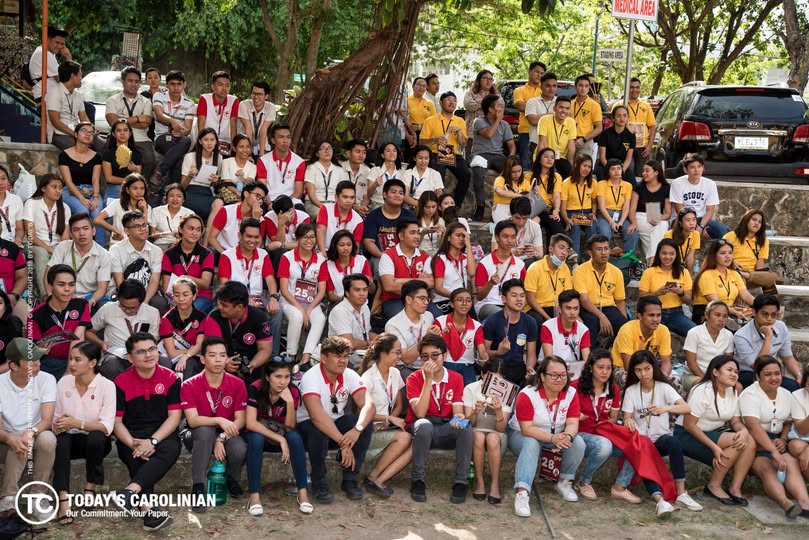
Photo by Lance Matthew Pahang
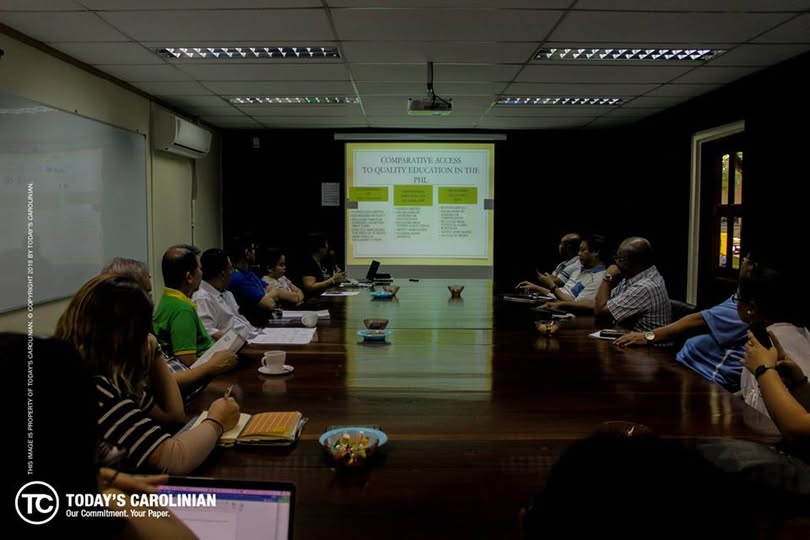
The University of San Carlos, together with Mega Cebu, Ramon Aboitiz Foundation, Inc. and other private and public sectors, hosted the third episode of Klarohay Ta! Candidates Forum for 2019 Elections last March 18, 2019 in the Theodore Buttenbruch Hall of the Downtown Campus. The senatorial candidates present for the forum were Marcelino Arias (Labor Party), Larry Gadon (Kilusang Bagong Lipunan), Danilo Roleda (United Nationalist Alliance) and Butch Valdez (Katipunan ng Demokratikong Pilipino). Candidate Imee Marcos was expected to attend, but failed to show up in the university.
According to Ferdinand Gujilde, election officer IV of the Office of the Provincial Election Supervisor, the event would serve to give the candidates a forum where they can advance their platforms of government and answer questions about various issues plaguing the country. Hosts Caroline Balisteros and Dante Luzon also emphasized the importance of Cebu during elections — as 3.2 million of voters are from the province, 60 percent of which come from the metropolitan area. Prior to the forum proper, the candidates first introduced themselves, in varying levels of coherence.
Arias presented himself as a lawyer practicing already for 45 years and a pastor of a Bible Baptist Church. He further stated that today’s society gives a lot of importance to the youth when the elderly like him can still do something for the country — to an audience mostly composed of the youth.
Gadon put emphasis that despite coming from the private sector, “the penalty of not participating in politics is being ruled by inferiors.” He also said that in the senate, he would serve as an inspiration for the youth, praising Cebu to be critical as opposed to his trademark “bobo”.
Roleda presented himself as passionate in serving the public, doing so for 28 years. His visions include free kindergarten and nursey education, and basic services such as healthcare in barangays.
Valdez, an auditor by profession, advocated the shift of the Philippines from a service-oriented economy to a production economy. This involves the empowerment of the Philippine economy’s agricultural aspects. He also called for truth, justice and peace along this planned development.
On their stand on federalism, Arias was in favor, claiming that it is a means for the government to get closer to the citizens. He also said that this is a means to eradicate he notion of “Imperial Manila”. Gadon was also in favor of federalism, as long as it is in parliamentary form. According to him, this was a way for a better and quicker distribution of wealth among regions. Roleda, however, stated that federalism is a good concept but is not timely. He explained that we must as a nation address local problems, including peace, order and resources, first. Valdez stated that we must first thoroughly consider the pros and the cons of federalism, as such a move has a large impact on the quality of life of Filipinos.
On death penalty, Arias stated that he is in favor for heinous crimes, citing that letting a criminal live through life imprisonment is costlier than imposing a death sentence. Gadon also said that he is in favor of death penalty —citing Christine Lee Silawan’s gruesome death and rape case. It has to be noted that as of the forum, her rape was already debunked during her autopsy. Roleda, however, was not in favor of the said penalty, instead advocating for the review and imposition of strict laws on life imprisonment, which he saw as a harsher alternative. According to him, death penalty is an easy way out. Valdez stated that he is not an advocate of the principle but may change his stance for heinous crimes, such as genocide — of which he mistakenly cited the Dengvaxia issue as an example of the crime.
On lowering the age of criminal responsibility, Arias, Gadon and Roleda were in favor. They explained that at the age of 12, children nowadays can discern between right and wrong. Roleda further expounded that children arrested would not be imprisoned, but would go to Bahay Pag-asa instead; notably, however, Bahay Pag-asa facilities are at a clear deficit throughout the country. Valdez, on the other hand, cited that juvenile crime is more of a socioeconomic problem as it is a problem of ethics. According to him, the state must instead help in rehabilitating the children to be better citizens instead of branding them as criminals. When questioned by the audience if lowering the age of criminal responsibility is congruent to lowering the age of consent, suffrage, making a contract and the like, the candidates clarified that different forms of maturity are present in such instances. Thus, these are not equivalent to each other.
On the scarcity of water, Gadon, Roleda and Valdez cited solutions for the long-term: Gadon on surface water collection, Roleda on pushing bills to implement plans on dam construction and Valdez on the construction of nuclear powerplants with desalination facilities in Cebu. Arias, however, went off-tangent and answered that we must stop relying on Japan and China to build dams, and instead must ask religious institutions for taxes.
On their stand on corruption, Arias pushed for freedom of information as a means of more transparency in the government. Gadon posited that advancing the people’s coalition on audit, which would frequently change its members, would help alleviate the problem. Roleda said that citizens are also accountable to the problem and must elect candidates of correct and righteous standing. Valdez stated that corruption is a connivance between public and private entities, and both must be held equally responsible.
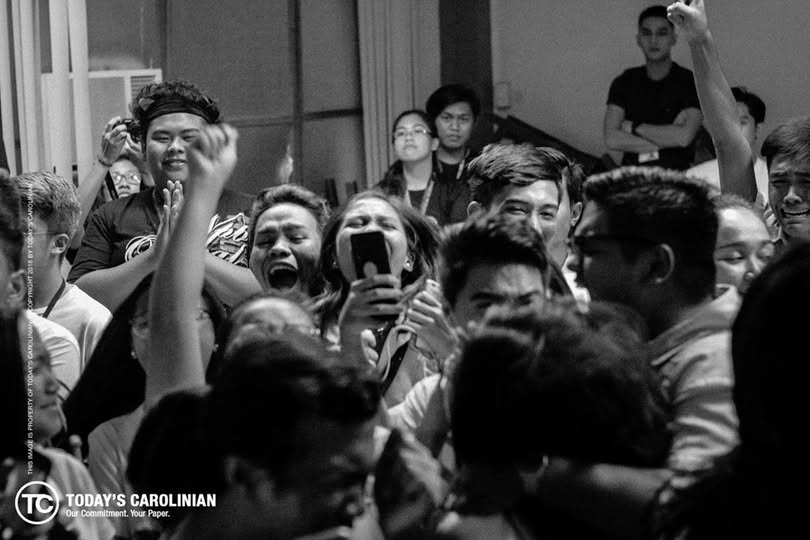
Upon further inquiry from the audience, however, Gadon found himself in a heated argument with a Carolinian student. The student called Gadon a liar when the latter said that there was no corruption during Ferdinand Marcos’s time as president. At this point, despite claiming beforehand that Cebuanos are not “bobo”, Gadon called the student as such, and Gadon further said that he was a more important person, which, as Carolinian viewers eventually pointed out, would somehow defeat the concept of public service. He also threatened to walk out if the student was not removed from the audience, but the organizers initially established that a warning should be given first before removal. Gadon did not go through his threat of walking out in spite of the student staying.
Notwithstanding being seemingly resolved during the forum, Gadon’s daughter Alarice posted a photo of the student without his consent in Facebook. In the same post, Gadon’s daughter aggressively stated that the student is a communist and is “yellow”, apparently believing a color is a strong insult. After drawing flak from Carolinian students and faculty members, Alarice Gadon deleted the post, but screenshots criticizing such post are still circulated in Facebook and Twitter.
Back to the forum, as a conclusion, the four senatorial candidates signed the Mega Cebu paddle as a symbol of their support for the projects of the organization.
The next episode of Klarohay Ta! will be on March 22, 2018. The said episode will feature party-list representatives from ALU-TUCP, Bayan Muna, Akbayan, Ako Bisdak, Ako An Bisaya, Magdalo, 1-AAAP, PBB, Gabriela and Ang Nars.