SOE holds first-ever Outcomes-Based Engineering Education Seminar
Photograph by Anthony Bernaldo
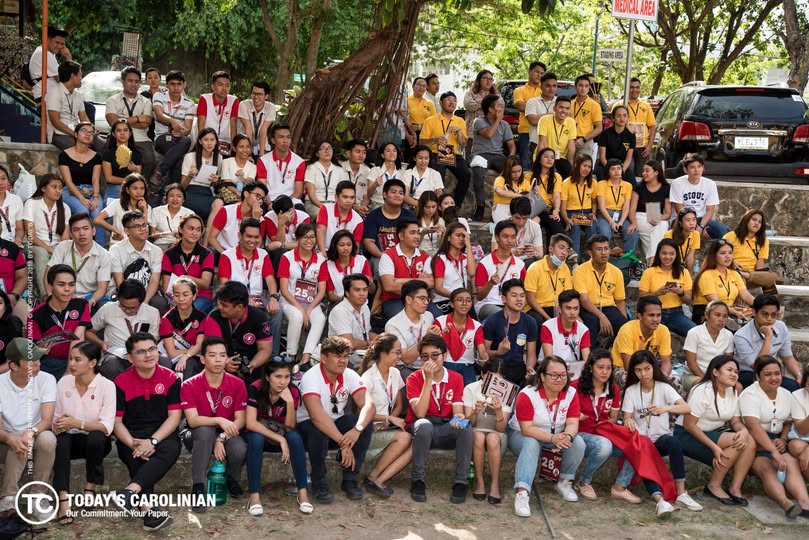
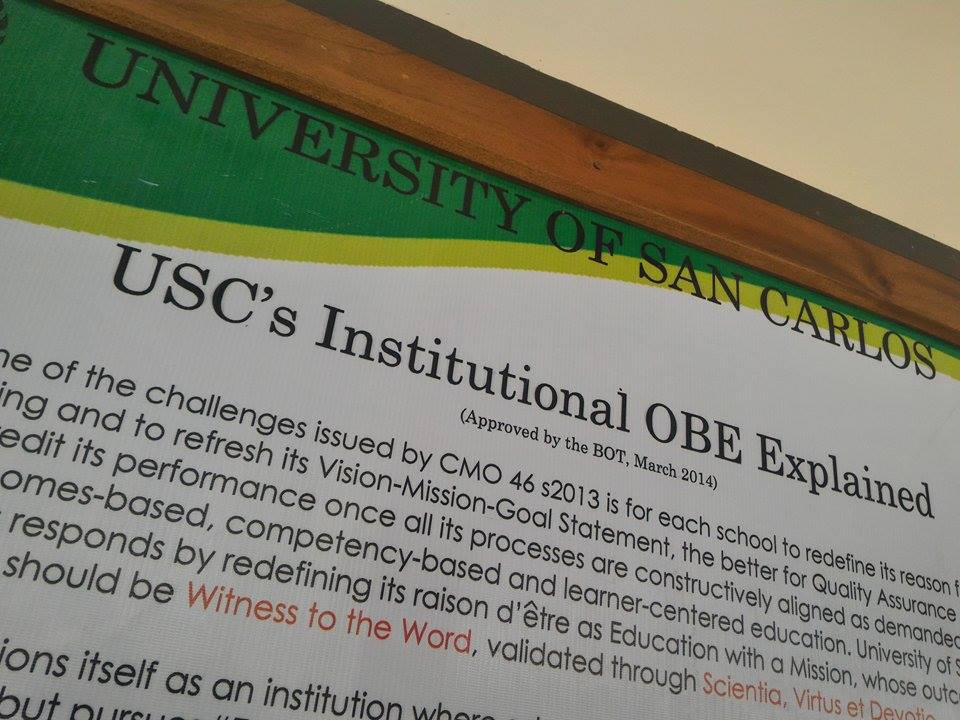
Different department chairman of the School of Engineering (SoE) conducted the first-ever Outcomes-based Engineering Education at USC Parents Orientation last August 28 at the Rigney Hall in USC-TC.
Engr. Ricardo Fornis, Assistant Dean of SoE, discussed the agenda for more or less than two hours. He emphasized the major contents of the CHED Memorandum Order no. 37 Series of 2012, and announced that there are three engineering programs which are already accredited by the Commission on Higher Education (CHED) as of June 2015, namely: BS Chemical Engineering, BS Civil Engineering, and BS Electrical Engineering. On the other hand, the visitation to the four remaining programs will be done on September 23 to 25 this academic year.
The main speaker, Engr. Luis K. Cabatingan (Curriculum and Instruction Development Officer), tackled about four major points: What is OBE, Outcomes-Based Teaching and Learning (OBTL), Why OBE, and the role of the parents in OBE.
For the first point, Engr. Cabatingan differentiated the two types of learning experiences, the formal and hidden curriculum, wherein the common outcomes that are expected of the learner are knowledge, skills, attitudes and values. He also gave some examples of learning experiences such as group discussion, oral presentation, team-building activity and doing capstone research with their corresponding outcomes.
On the next point, he highlighted that Program Outcomes (POs) are the bases for designing the program and elaborated the Engineering Program Outcomes set by the Philippine Technological Council (PTC) and prescribed by CHED. These can be found on the syllabi of all the courses within the programs. The Course Design, which is Outcomes-focused, has the Syllabus as the ‘planning stage’ and Teaching-Learning as the ‘delivery stage’.
Moreover, he clearly defined that: 1) the Carolinian Attributes (Scientia, Virtus, Devotio) are the guiding value system throughout life; 2) Program Educational Objectives (PEOs) are achieved three to five years after graduation; 3) POs are achieved upon graduation and supports the achievement of PEOs; and 4) Course Outcomes are achieved at the end of the course and supports the achievement of POs.
“A students learns what he does, not what the teacher does,” stated Engr. Cabatingan.
He concluded the second point by citing the two types of learning: understanding (know-what and know-why) and ability (know-how). “Most learning experiences happen outside the classroom,” he added.
He introduced the third point by describing the function of the Washington Accord – an international institution responsible for accrediting engineering degree programs – wherein under it is PTC as a provisional and not a full member yet. Also, he explained that the adoption of OBE will break the hindrances that the 15-year Philippine Education built against the 16-year international standard.
The last point was realized through an open forum among them, wherein it was clarified that OBE is far different from k-12 and that it is significant for the parents to assure that their sons and daughters wouldn’t be left out from constantly passing the courses.
The other chairmen who attended were Engr. Ramelito Agapay (ChE), Engr. Janice Jamora (CE), Engr. Antoniette Mondigo (CompE), Engr. Isabelo Rabuya (EE/ECE), Engr. Francis Mayo (IE), Engr. Joseph Karl Salva (Asst. Chair, ECE), and Engr. Christine Marie Gohetia (Faculty, CompE). Parents of students mainly from the Chemical Engineering (ChE) department participated, and a few from Electrical Engineering and Electronics and Communication Engineering departments.