Spoliaria
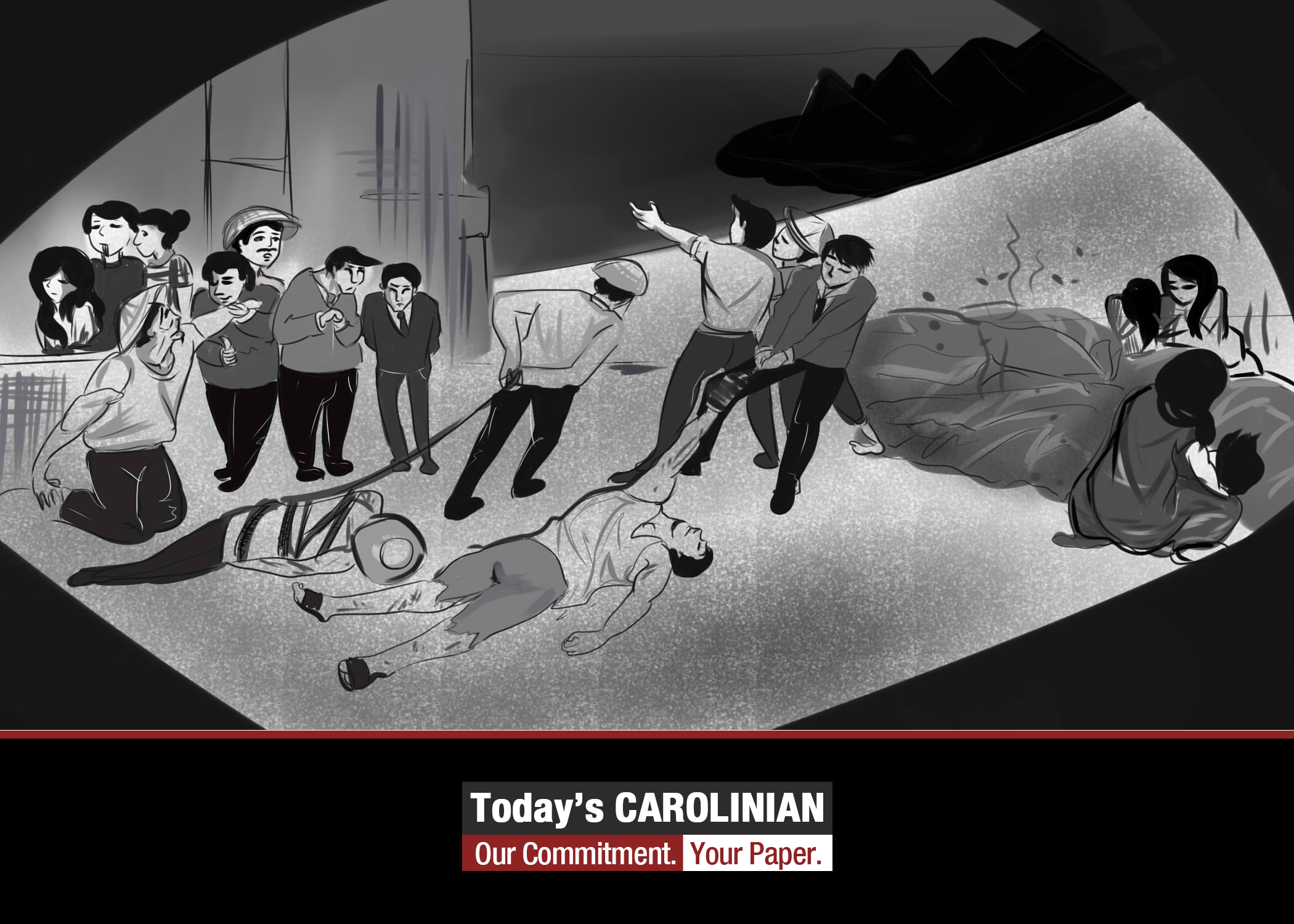
Illustration by Geralden Morre
In the arena, they were fierce warriors — gladiators — perhaps fighting for fame, perhaps for freedom. Now, they are nothing but a legion of corpses, their blood leaving gruesome paths in the dimly lit chamber as they are dragged by soldiers whose names they will never know. To one side, spectators — a crowd of the opulent and the deprived — witness the ghastly sight, waiting for the chance to scavenge whatever they can from the cadavers. To the other, a woman sits on the cold stone floor, weeping for the dead in her tattered dress, accompanied by a man wielding a torch, as if searching for his kin among the cadavers left to rot in a heap. Such is the scene shown by Juan Luna’s Spoliarium in macabre yet glorious detail.
Luna finished the Spoliarium using oil on a 4.22-meter tall and 7.68-meter wide poplar panel in around 1884. After working on the painting for about eight months, the artist then presented his Romantic masterpiece in the National Exhibitions of Fine Arts in Madrid in the same year. In the exposition, the painting earned Luna the first of three gold medals. Afterward, in 1886, the artist sold the painting to the Provincial Government of Barcelona for 20,000 ESP. Today, the Spoliarium welcomes visitors to the National Museum of the Philippines in Rizal Park, Manila.
When it was first presented, Spoliarium, which pertains to the eponymous great chamber beneath Roman amphitheaters where the dead are stripped of their armors and then piled, instantly left an imprint of the oppression that the Filipinos suffered under the Spaniards. As Graciano Lopez-Jaena remarked, the painting is “the living image of the Filipino sighing its misfortune; the Philippines is nothing more than a real Spoliarium with all its horrors.”
Additionally, during the celebration of the painting’s victory in its exposition along Felix Resurreccion Hidalgo’s Virgenes Cristianas Expuestas al Populacho, Jose Rizal commented in a speech that the Spoliarium accurately depicted the corrupted moral, social and political life of the Filipinos under the Spanish rule. He then admitted that Luna’s masterpiece was one of his inspirations for Noli Me Tangere, which he describes as “the Latin echo of the Spoliarium”.
However, the impact of the Spoliarium did not just cease as the Spanish regime in our country came to a conclusion. Presently, the entire scene portrayed in the painting still rings true — the waiting spectators, the downcast kinsmen and the dead gladiators — though in an entirely new context.
Majority of us are the dead gladiators. We are constantly oppressed by those in power. However, what makes our case worse is that we ourselves volunteer to submit to this tyranny. Our fear, our apathy and our fanaticism have made us victims to those who abuse their authority. When we examine our social condition, we are nothing but corpses dragged by institutions — our government, our religion and even our universities. Instead of helping us, these bodies waste our potentials, and we do nothing as a response, allowing this injustice to happen to ourselves.
Stranger than this, we also have the tendency to surrender ourselves to be the dead gladiators to the inanimate or the benevolent, becoming slaves to unwilling masters. How many of us worship one brand over another merely because of its name? How many of us have elected someone without leadership skills to office merely because we see him or her as miraculously good? How many of us do goodwill out of fear of a hell that may not even exist?
Aptly, the aforementioned institutions are the soldiers and the spectators. Aside from dragging the dead on bloody paths, these agencies lie in wait to ransack whatever they can do so from us. To conceal this, we are offered promises and miracles — a brighter future for our nation, a more peaceful world under whichever god’s rule and even quality education — and in these desperate times, we are left with nothing but to bite the bait. We then become milking cows for these institutions — our money and our abilities being exhausted until none is left for us. This cycle of slavery and submission to slavery may never cease to exist, considering how abusive those who rule are and how indifferent and cowardly those who are being ruled over are.
However, we ourselves may even be these soldiers and spectators to our fellow men and women. How many times have we refused to help those in need merely because it does not serve our current interest? How many times have we used one another to succeed in whatever pursuit we have? How many times have we turned a blind eye to the injustices surrounding us because they have no significant impact to where we are? We cannot just blame abuse on those in power because it is more convenient for us to do so; often, even we are horribly guilty for the injustice that others face.
Lastly, the weeping kinsmen are those aware of the present situation but are powerless to do anything significant to it. Gone are the days when the likes of Andres Bonifacio, Jose Rizal and Juan Luna could manage to do a significant change to society, as the corrupt spectators and soldiers of the whole show are bound to act against them. Making matters worse is that instead of giving these would-be heroes our stand, our voice and our power for them to declare victory, we let our apathy, our egocentricity and our fear hinder their way to triumph.
Having said all of these, we may view ourselves as the dead gladiators, but to some, we may be part of those who weep because of our powerlessness, with all our effort amounting to nothing. Unknown to us, we may even be one of the crowd, waiting to get his or her share of the spoils from the dead. Our role in one Spoliarium of a person may be substantially different from that of another.
Therefore, each one of us carries his or her own version of the Spoliarium, and the world is one immense chamber — a collection of the many Spoliaria of its people.