APEC SME Summit Pushes Boundaries
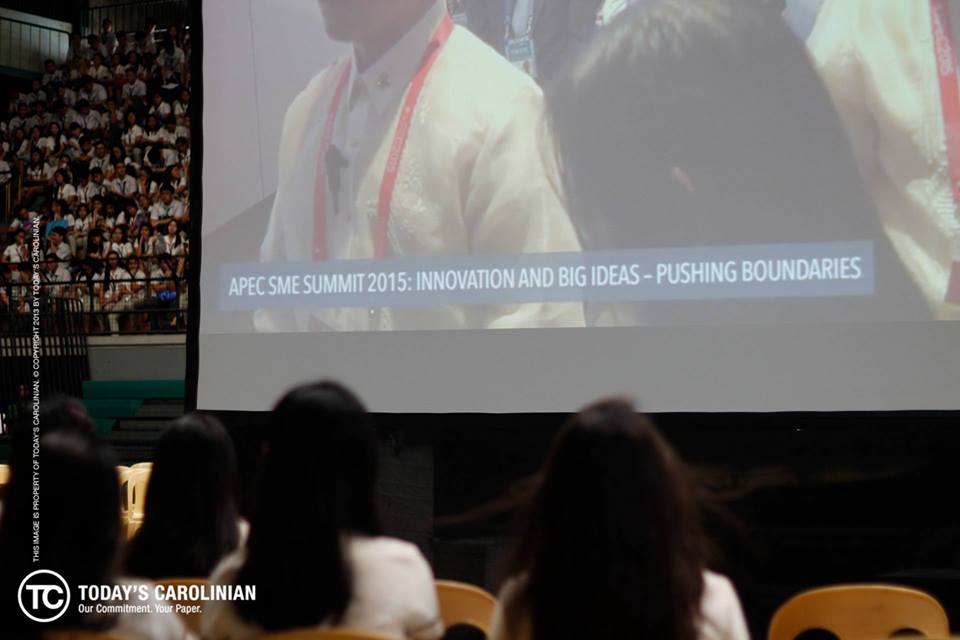
Photo by Andrew Esposa
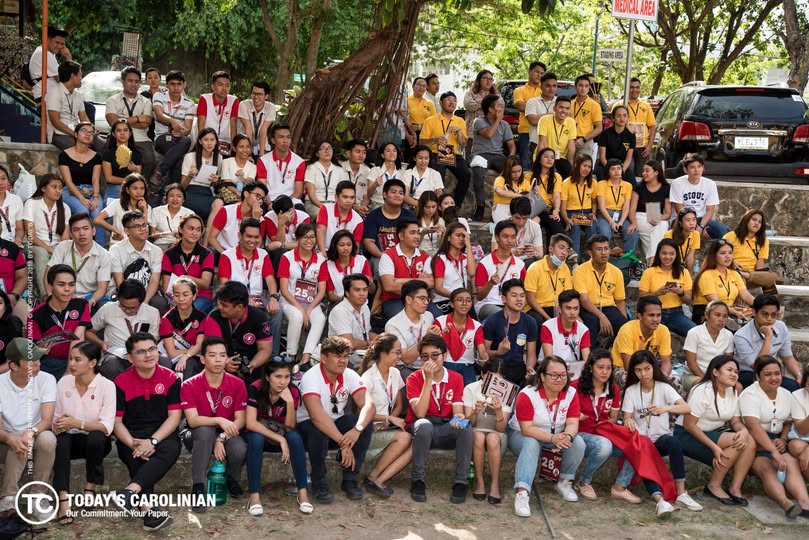
In line with the APEC 2015 theme: “Building Inclusive Economies, Building a Better World,” “Innovation and Big Ideas: Pushing Boundaries” was the theme for this year`s APEC SME Summit held in Green Sun Hotel, Makati. As initiated by the APEC Advisory Council (ABAC) in Manila who was looking for linkages in Cebu for an extended audience of the summit, a livestreaming was spectated by the students of the School of Business and Economics in the USC Gym in Downtown Campus today from 8:00 a.m. to 5:00 p.m.
The Asia Pacific Economic Cooperation (APEC) is a movement that was established in 1989 to promote free trade between the economies within the Asia-Pacific region. There are currently 21 member economies including Australia, Canada, South Korea, Japan, China, Singapore, USA, Mexico, Russia and the Philippines. Annually, there is an APEC Economic Leaders’ meeting that is attended by the heads of the government of APEC-affiliated countries. A rotation of the meeting’s location happens annually among the member economies.
Since hosting the 1996 summit, the Philippines has shifted its focus towards small and medium enterprises (SMEs), which comprise 75% of the jobs in the country. The Filipino people, which Pres. Benigno Aquino III referred to as “our strongest competitive advantage and the best resources,” have shown entrepreneurial interest by establishing small-scale businesses like sari-sari stores.
Apart from the economical enhancements that were presented by Aquino, successive sessions were also conducted by speakers from different countries. “First of all,” Aquino said, “this is an economic forum,” so questions were permitted after each discussion as a form of interaction. The APEC SME Summit 2015 featured a number of speakers, all of whom are successful business owners ready to share what they know about what they do and how they do it. Speakers shared their experiences, insights and stories to show the SME owners that there is something for them in the future if they learn to “rethink and recreate the way they do business.”
To kick off the summit, Josette Sheeran, the president of Asia Society, talked about the rise of connectivity; cities, in which Manila ranked second; and even self-empowerment. She mentioned the Philippines’ suitability for hosting the SME summit, as SME’s comprise 99% of the country’s businesses and over half of its labor force. Furthermore, according to an article from the Philippine Star, although SMEs play an important role in our economy, they comprise only 30% of the Philippine GDP. Considering the number of SMEs in the country, it is vital to our economy that we help our SMEs grow and succeed.
Ms. Sheeran was succeeded by David Plouffe, the senior adviser of the popular ridesharing app Uber Technologies, Inc., who shared about the increasing demand for transportation and how current innovations responded to such need without the accrual of expenses.
Tony Fernandes, CEO of Air Asia, explained the importance of branding and people in a business. “You only have one life. Don’t be afraid of failure,” he said, addressing SME owners.
Another speaker was Sheila Marcelo, founder and CEO of Care.com, who expressed how an innate capability of man can be an expensive commodity surpassing home and mortgage expenses.
These were followed by other business owners and executives including Maria Ressa of Rappler, Nix Nolledo of Xurpas, Dexter Ligot-Gordon of Kalibrr, Angelo Umali of Simple Wearablesand Barbara Navarro of Google. All of them shared the stories of how they, as entrepreneurs, and their businesses came to be, with a common message: not everything that can be invented has already been invented. Innovation is always possible as long as you are passionate about it and even multi-billion-dollar businesses started small.
Throughout the conference, poll questions were asked to the audience. By downloading an app officially used by the conference, anyone could participate in online answering and commenting.
According to Mr. Kristian Marc Cababug of the Department of Business Administration, the livestreaming of APEC SME Summit 2015 was mainly offered to School of Business and Economics (SBE) students to extend their knowledge in their fields. The summit, geared towards innovation, collaborative economies and discipline as a country, carried many important lessons from those who have reached the top.
Meanwhile, Marionne Yap, the president of the Carolinian Economics Society, said that the result of our hosting of APEC is that “we can expect more improvements in the issues concerning our country as they are able to showcase new and innovative ideas that will help us promote our nation’s development.”
Other courses outside of SBE and even the university itself were also invited to watch, such as Southwestern University, Cebu Institute of Technology-University and Asian College of Technology.