Big Church and Small Chapel
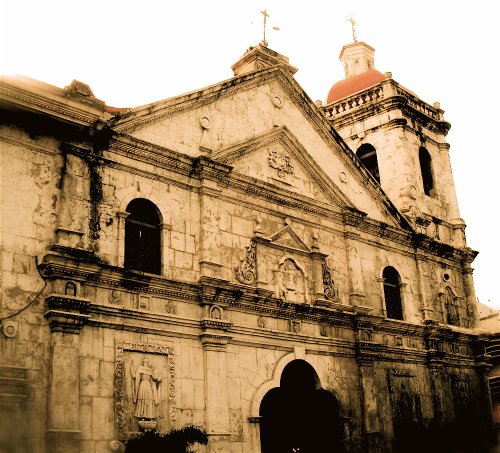
Image Source: http://goo.gl/HMNwfS
The Philippines has a rich heritage, history, tribal culture and religion that grab reflection in its festivals and traditions. Cebu, as in the case of the entire Philippines, has a rich history mostly of Spanish influence as Cebu became a colony of Spain more than 300 years ago. Cebu, Sugbu as it was known then, has a rich cultural legacy that became one of the foundations of the country’s existence.
When we talk about Cebuano history and heritage, one of the first things that come into mind is the Basilica Minore del Santo Niño situated at the heart of downtown Cebu. The basilicais one of the oldest religious relics in the Philippines, having been constructed in the 16th century. It was founded by an Augustinian priest, Fr. Andres de Urdaneta on April 28, 1565, the very day when the Legazpi-Urdaneta expedition arrived on the island to formally Christianize the Cebuanos.
The first church was built in the year 1566 by Fr. Diego de Herrera using only wood and nipa. The church was built on the site where the image of the Holy Child was found. Unfortunately, the building was destroyed by fire. In the year 1605, Fr. Pedro Torres started the construction of a new church, still made of nipa and wood. It was finished in 1626 but was again burned in 1628. In the same year the church was burned, Fr. Juan Medina began the construction of yet another church, but this time, with the use of stone and bricks. The construction was stopped because it was found to be defective.
On February 29, 1735, Father Provincial Bergaño, Governor-General Fernando Valdes, Bishop Manuel Antonio Decio y Ocampo of Cebu and Juan de Albarran Prior of the Santo Niño, initiated the foundation of another church using stone. Aid came from many sources, including Fr. Antonio Lopez, Fr. Francisco Aballe and districts of San Nicolas and Talisay.
According to Augnet.org, a website that references Saint Augustine of Hippo and the Order of Saint Augustine, the construction of the church was not as easy as we would imagine. The stones used were imported from Capiz and Panay by an army of bancas. The molave wood came from the high mountains of Talisay and Pitalo, and was transported in bancas coming from Argao and Carcar. Despite these difficulties, Fr. Albarran did not lose hope, but the challenge in building our very own church did not end there. The lack of chief officers and craftsmen forced Fr. Albarran to acquire some knowledge on architecture. The church was then finished not later than 1739.
The original features have been retained except for the windows that were added by Fr. Diez in 1899. In 1965, the church underwent restoration on the occasion of the fourth centennial of the Christianization of the country. Cardinal Hildebrando Antoniutti, Papal Legate to the Philippines, bestowed the church the title of Basilica Minore, a special privilege granted to the Augustinian Order by the Pope Paul VI. The former President Ferdinand Marcos declared the Sto. Niño Basilica a national shrine because of its historical significance.
Today, countless devotees visit the basilica to attend the Friday Novena Mass. The numbers continue to increase over the years to a point that people could easily fill the Basilica beyond its capacity. Because of the generous contributions donated by the devotees around the world, an open-air and theater-like structure was built and completed in September 1990. It can accommodate 3,500 people. The structure is also called The Pilgrim’s Center and is used for Holy Mass on Fridays and other religious festivities.
The basement of The Pilgrim’s Center contains a museum. This area houses the Santo Niño vestments in various sizes. Most of these vestments are of the 17th to 18th century style. Precious jewelry such as rings and necklaces are placed in a display cabinet. These church pieces are used during liturgical services.
Located near the Basilica Minore del Santo Niño de Cebu and in front of the Cebu City Hall is the Magellan’s Cross. The cross was brought by Ferdinand Magellan, a Portuguese explorer and navigator. Ferdinand Magellan was working for the King of Spain in search of the “Spice Islands,” which are now part of Indonesia, known as Maluku or Moluccas Islands. According to the University of Hawai’i System, when Magellan and his crew landed on Cebu, he met a native chief, Rajah Humabon, and befriended him. The native chief, his wife, and his warriors agreed to accept Christianity and consequently be baptized. He planted a cross on Cebu’s terra firma to commemorate on the important event about the conversion of its locals to Christianity. The original cross is apparently encased in another wooden cross for protection as people started clipping it away because of the belief that it had healing powers. This persuaded the government officials to encase it in a “tindalo” wood and secured it inside a small chapel called “kiosk.” There are rumors that the original cross was destroyed or disappeared after Magellan’s death. The one displayed is said to be a replica of such cross. It is housed in front of the present city hall of Cebu, along Magallanes Street (named in honor of Magellan).
The Basilica and Magellan’s Cross are popular symbols of Cebu, the Cebuano and the Cebuano faith. The Pilgrim’s Center is most of the time stuffed to the rafters with people who light candles, pray to the Holy Child and sing “Bato Balani sa Gugma” in the most heartfelt way. Many tourists also make it a point to include the church in their travel itinerary. During the Sinulog Festival, an endless sea of people come together, brave the heat or endure the rain to honor and pay homage to the Sr. Santo Niño. The Novena masses at the Basilica are very well-attended. Because of all that’s happened in Cebu, the centuries-old Cebuano devotion continues, now more than ever, with fervor and fire like no other.