Booty is in the Eye of the Beholder
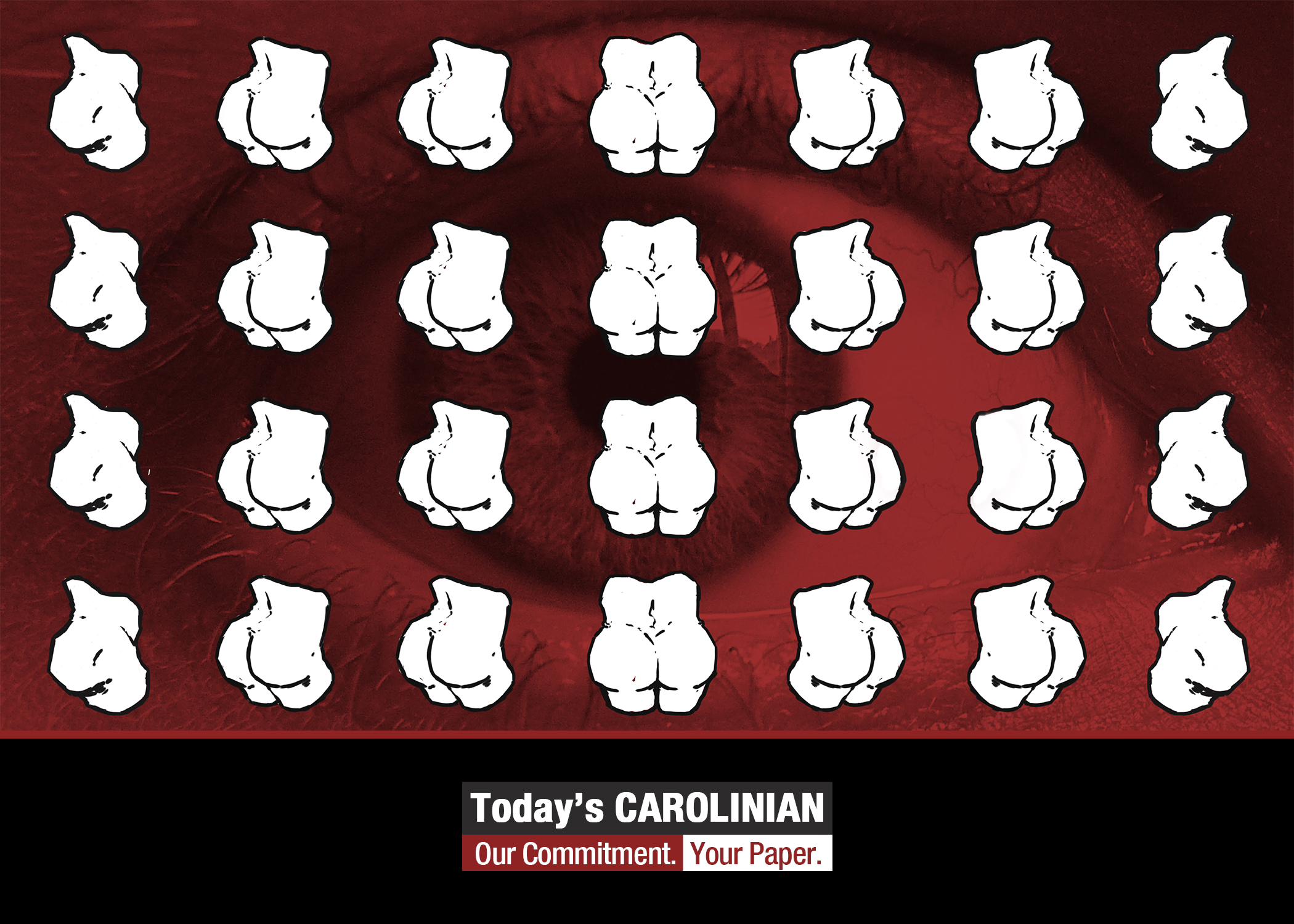
Illustration by Eduard Jude Jamolin
“I like big butts and I cannot lie.”
–Sir Mix-A-Lot, “Baby Got Back”
Throughout history, great men and women have sprung from the common masses, inspiring throngs of followers to join them. Men like Socrates, Voltaire and Confucius used their words to bring the human race to a new standard of thought, unlocking the potential stored within the mind itself.
Now, in 2017, we are smack in the middle of the rise of a new class of thinkers. Derulo, Minaj and Azalea are only the latest trailblazers in a discipline that concerns itself not with moving forward, but with what is behind us.
However, the cultural prominence of our butts has been prevalent since long before the new millennium. Many of us lambast the prevalence of the butt in the modern music scene, especially in pop and hip-hop, but truth be told, Mozart himself was unable to resist the allure of the butt. His 1782 composition “Leck mich im Arsch”, a six-voice canon translating to “lick me in the arse” — although in today’s context “kiss my ass” would be the most faithful translation — speaks to our enduring infatuation with the buttocks not only sexually, but also as a tongue-in-cheek insult.
From a historical perspective, not even Mozart was the first to make art out of the butt. The Roman statue of Venus Callipyge, thought to be a knockoff of a lost Greek original, depicts an anonymous woman commonly thought to be the goddess of love thoughtfully evaluating her painstakingly-sculpted buttocks. Several prints from the Ming Dynasty exist comparing the butt to the bright full moon, a sentiment echoed by juvenile delinquents the world over. For centuries, the butt has been associated with fertility, youth and sexuality. Although today we focus mainly on the lattermost, one thing is obvious no matter what century one looks at: from the comedic to the carnal, our appreciation for the butt is certainly well-rounded.
The human fascination with the butt is, in truth, not even uniquely human at all. It stems slightly further back in our evolutionary history from the primates that we split off from not too long ago. Take, for example, the male mandrill, whose buttocks are quite possibly the proudest in the animal kingdom in not only sheer size, but also in their hues of vibrant blue and red practically unheard of in any other mammal. Pride in our butts is simply another piece of the puzzle linking us to our simian ancestors.
Although less impressive than the mandrill’s, the human male butt is also very popular. Despite this, its admiration is often carried out much more quietly than its female counterpart’s. Dozens of studies and papers have been published on exactly what it is about a woman’s behind that makes her admirers tick, but for all of these, very few exist to dissect the appeal of the male butt once the baby-making aspect is removed from the equation. Research by Dr. Kerri Johnson of UCLA suggests that, from its impact on body movement to its muscularity, the male butt contributes more to the body as a whole than it does as its own entity. Contrast the female butt, which has entire songs dedicated to it.
This is where many of the complaints lie with the butt’s upswing in popularity: it creates a culture which reduces women to a pair of buttocks before giving them its attention. The butt serves many societal roles: object of affection, site of intimacy, playground insult, and for many, yet another unreachable ideal to aspire towards. Slowly, we are realizing that appreciating our bodies, butts included, is an important part of loving and caring for ourselves. The difference between empowerment and objectification, however, still eludes many of us despite being a very easy line to draw.
The simple answer is that the difference lies in who holds the power. We own our butts. No one else can shame us or pressure us into pretending that they are all that we are. In the opposite direction, but equally important, none of us have the right to police another person’s butt, be it in a skirt, sweatpants, jeans or none of the above. There is no shame in appreciating butts — it is simply how many of us are wired. Reducing a whole person to simply their body is where the problem lies, and although this mindset is only increasing in popularity, it is also bringing forth critics who are unafraid to lay bare all the problems with these ways of thinking, no matter how widespread they are.
As the butt moves further into the forefront of new media, it opens up new conversations not only about sex and sexuality, but also body image, self-esteem and culture. They may be at our backs, but without us even realizing it, our butts truly do teach us to move forward.