CJ Sereno delivers Ulat ng Hudikatura
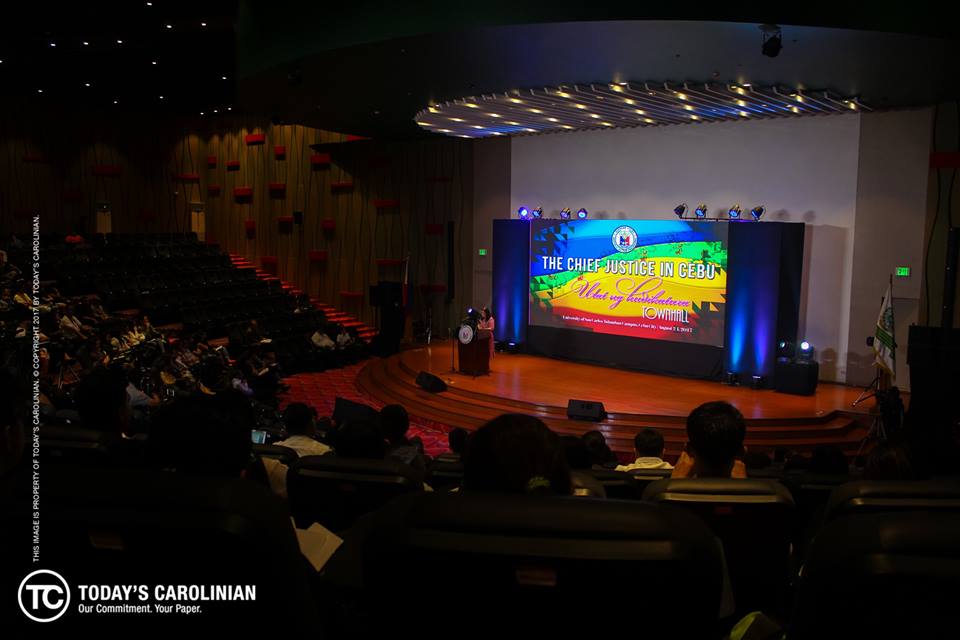
Photo by Keith Ayuman
History was made in the very halls of the Michael Richartz Building, USC Talamban Campus as Chief Justice Maria Lourdes Sereno delivered the first ever Ulat ng Hudikatura (Report of the Judiciary) outside Luzon last Aug. 24, 2017. Lawyers; various people from the media; members of the administration, faculty and law students from the University of San Carlos (USC) and other invited guests graced the event.
To commence the event, Sereno was introduced after the singing of the Philippine national anthem. Her speech started off with the two significant Cebuanos who had taken part in the judiciary as chief justices before, namely: Marcelo Fernan and Hilario Davide, Jr. The former served from 1988 to 1991 who first initiated the Continuous Trials Program, wherein the guidelines for it will be implemented nationwide on Sept. 1. The latter served from 1998 to 2005 and spearheaded the action program for judicial reform. Sereno went on to say, “Mabuhay ang Cebuanong abogado.”
She then addressed the law students in the venue, explaining the importance of the legacy left by Filipino ancestors who have fought for freedom and independence against foreign threats. She said that the young Cebuanos are the heirs of revolution, that Cebu City is the shining hope of the nation. Furthermore, she emphasized certain points that they must uphold when they practice the legal profession; it is to not give in to the weariness that has affected the previous generations, to fight for which ground they stand on and to rise up to be better than their elders.
Sereno further said that the older generations have continually strived for implementation of the needed changes, as much as they can to be able to build a more solid foundation for the younger ones. This is so they may have a chance to practice in a better court environment and rise higher. These changes include the reforming the rules and the modernization of the courts, building intelligently-designed courthouses and putting in more resources for the convenience of future lawyers.
Problems regarding the justice system in the country were already addressed by different implemented rules. According to Sereno, though the number of resolution of cases is higher now, it still cannot be denied that justice is slow and inaccessible.
Also according to Sereno, reforms are stirred by a deep empathy for the people on the margins and those outside the centers who have lesser access to lawyers due to problems in money, the distance of places for justice and lesser access to information as well.
These reforms are in the form of decongestion officers to help decongest courts all over the country which is an expansion of the project “Hustisyeah!” participated by law students. Hustisyeah! is a clear example of the youth’s potential in dictating country’s future.
A large amount of money is also set aside for the judicial complex in Cebu City and for the expansion of the Mandaue Hall of Justice. It was also said that Region Seven is one of the first four regions where Internet connectivity is available in all courts. In addition, there is also the “Justice on Wheels Program” where it enables a makeshift court for the sake of those people in far-flung areas in the country; this has already facilitated the release of over 9,000 prisoners.”
E-Courts is an automated case management system developed for the trial courts to increase court efficiency and transparency, wherein lawyers can file pleadings by uploading them online and track the status of cases. They can also view case records through their computers or smartphones. Electronic notices are sent through email or SMS. Because of this, judges are able to issue almost all court orders in a small span of time; this can also help reduce the file of papers in the courthouses.
On Aug. 25, 2017, the principals of the Justice Sector Coordinating Council comprising of the Department of Interior and Local Government, Supreme Court and Department of Justice will meet in Cebu City to determine if the city is ready to become a justice zone.
Sereno stressed that the Filipino youth are the rising heroes of justice. She invites them to join the judiciary and to be a part of their cause. To conclude her speech, she addressed the law students once again to continue pursuing what is honorable and right, and to hold on to their principles no matter how inconvenient. Finally, she told the law students to be the future lawyers who must do something noble, good and righteous.
The second half of the event was an open forum with the panel comprised of USC law students, faculty, and media personnel. The questions that were raised pertained to the impeachment complaints against Sereno to tips on how to know if you’re suited for the legal profession to the discussion on reforms of the slow dispensation of justice.
“This is not the occasion to give up hope. In fact, this is the occasion for us to come together and move forward with reform,” stated Sereno. She expressed her regret on the neglect of the judiciary to make necessary reforms decades ago which could have prevented the people from having frustrations with the justice system.
Furthermore, questions from people on Twitter and from the audience were also accommodated, giving Sereno the chance not only to talk about pressing issues like extrajudicial killings but also her career and personal life. The event ended with a photo opportunity for the audience.