Praise, Prayer, and the Quotidian
TC Days 2013 is a week celebrative of the University of San Carlos’ Talamban Campus. The Campus that has garnered fame for housing students that fit the description: “bahala’g rugged basta educated.”
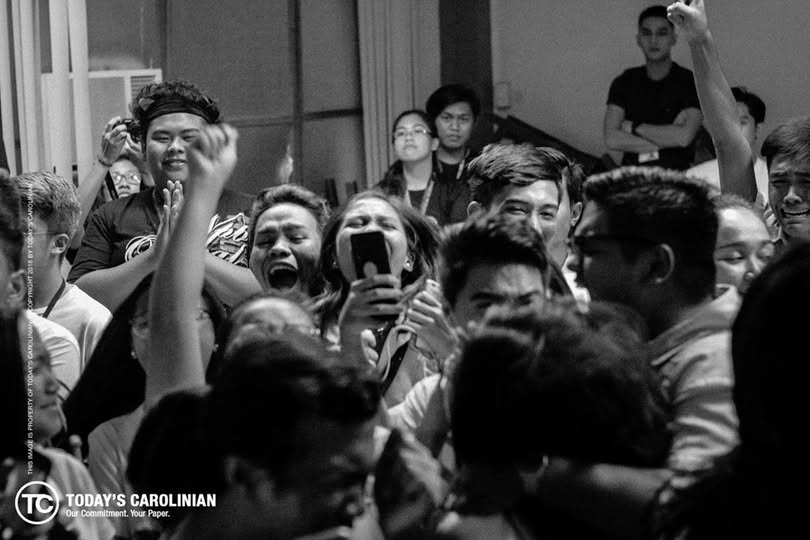
Included in its weeklong celebration is hosting Praise Jam – an activity wherein people of different religions gather together and sing songs of atonement, selflessness, and praise for their almighty creator, whoever that may be.
However, in this predominantly catholic institution, it is only to be expected that Praise Jam celebrated the Catholic and Christian life and its savior, Jesus Christ. This is no hindrance, of course. If one is of a different religion or has a different course of conduct then one can always tune out or replace particular names mentioned and the message would still get across.
Faith, regardless of religion, is still faith.
And with this, it is safe to say that praise jam was one event that encompassed the boundaries set by one’s religion. People sing, dance, and raise their hands to songs like ‘One Way’ and ‘How Great is our God’ and feeling every moment of the night as they close their eyes in surrender.
One of the best parts of praise jam was a discussion on the slowly changing view on morals and the current culture of the Filipino youth, who belong to Generations Y and Z, in the Philippine context. The Philippines has always been a predominantly catholic country whose culture has always welcomed the conservative. However, in recent times, globalization has shipped glimpses of many-a-different culture to the country that has changed the usual view of Filipinos on family, sex, culture, and even the way we view life and how we live it.
The discussion opened with how loose the youth has become and how much values have degraded. According to the discussion, people are now open to the idea of pre-marital sex and that some even go as far as equating relationships to sex. There was also the notion of abortion and contraception, family and education, happiness and hardships.
Do we go and accept the fact that people are now open to the idea of being in loose, casual relationships? Do we only cry out to God during hardships and not call on him when we are happy? Do we forget the value of family as we strive for self success? Do we study so hard that we forget those around us?
These are questions that come to mind as we realize that our surroundings enshroud tolerance towards values once given great importance. Quotidian songs around us like ‘Get lucky’ by Pharell featuring Daft Punk shadowed messages that allow the youth to think that partying, sex, casual noncommittal relationships are okay. The song ‘Marry you,’ a well loved song by Bruno Mars was also given emphasis – it was said that the lyrics promoted relationships that were based on impulse and not on mutual understanding and companionship.
Believe, Trust, Love. Those are the themes for Praise Jam 2013. Yet how do we believe, how do we trust, how do we love, if we condemn the sins of others in the first place? The Filipino view of morals in terms of Family, Sex, and Culture may gradually be changing but this does not suffice transcending the traditional.
Even Pope Francis remarks, “Does He (God) endorse the existence of this person with love, or reject and condemn this person? We must always consider the person.” As surprising as it seems, Pope Francis puts the person ahead orthodox beliefs. The mission of the church to heal the wounded should be superior to traditional views on ethics and morality in the hierarchy of truths, a catholic theological term that refers to truths being unequal in weight and urgency. There should be love over tenets, over rules, and over dogma. “Their (A person’s) dignity runs deeper than their failure,” Juan L. Mercado, writer for Sun.Star, writes in agreement with Pope Francis’ brave statement.
We see people being condemned for the way they live their lives and we see the same people turning away and losing their faith. Why should they, why should we, seek shelter in a church that condemns? Pope Francis did not deny the dogmatical and the doctrinal. However, what he called for was a shift in focus: from condemnation to healing and acceptance. Love over dogma.
In the story of the Prodigal Son, the prodigal son, the son who lost his way, the son who stole from his father, is welcomed back by the same person, by his father, into his arms and offered food and drinks. The prodigal son is scorned by his brother for leaving their father and betraying the family but he is given a feast for coming back into the arms of the father he thieved. But what few notice is how this son offered to reduce his status from a wealthy son to a mere worker. In the same way, how most of us focus on the sinner’s sin and disregard the humanistic want of change in the sinner. But this is what the father sees and he is happy to know that his son has come back to him.
If one has read the bible, one would also recall reading how Jesus Christ wandered for three years: taking to the streets, bringing his ministry and embracing us sinners. He welcomed us into His ministry, into His arms, and forgave us for all that we have done wrong. And He declared the clerics who would discriminate against the sinners as a “brood of vipers” and “white washed tombs.” He offered the poor, the powerless, the sinners, the outcast, the untouchables, and the nonbelievers: friendship and forgiveness instead of excluding them from his ministry.
Our ‘God’ saw everyone on equal footing and loved unconditionally. He considered the human person above every objective ethical discussion on ‘what is right’ and ‘what is wrong.’ That is our God. And that is what Pope Francis’ reminds us to do. And that is what we should strive for, not just as Christians, but as human persons, individuals with dignity, whichever religion we come from or whichever system of belief we attest to.
Praise Jam was a great way to sing of the almighty miracles of God in our lives. However, it condemned the acts of the youth, established what was ‘right’ and ‘wrong’ in their own standards instead of offering communion and truly and fully opening their doors to the sinful. We must always remember not to judge others just because they sin differently than we do.
Faith over dogma.