The Great Gatsby: Of metaphors and truths
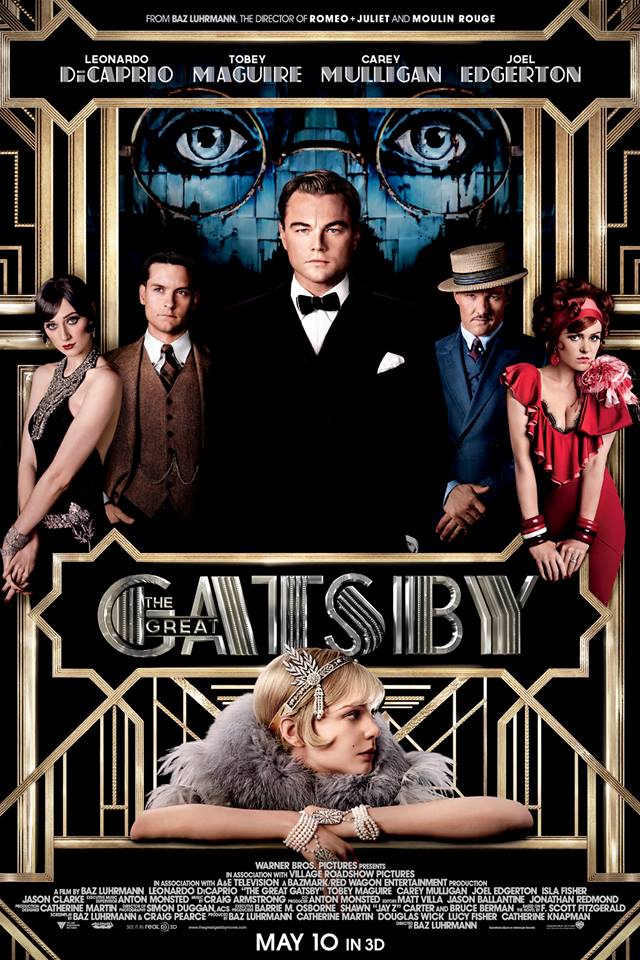
The Great Gatsby is a book written by F. Scott Fitzgerald and was published in the year 1925. It was met with excellent reviews. To this day, it is considered a classical work of American literature because it explores the darker side of America’s Jazz Age, which was contextualized after World War I, in the 1920s- the “Roaring Twenties”. Just this year, it was adapted into a film that was co-written and directed by Baz Luhrmann, starring Leonardo DiCaprio, Tobey Maguire, Carey Mulligan, Joel Edgerton, Isla Fisher and Jason Clarke. I wouldn’t want to narrate the timeline and spoil the story- the book is highly recommended to read by critics if you haven’t read it yet, and the movie might be quite confusing if one was too assuming of the literal.
The Great Gatsby occurs in the 1920s where people partied a whole lot- and by a lot, we mean lavishly a lot. The story is in the context of New York, and is narrated by Nick Carraway (Tobey Maguire) and begins when he rents a small house in the fictional place of West Egg in Long Island, right next to the unreasonably exuberant mansion of Jay Gatsby (Leonardo DiCaprio). During this time, the U.S. attempted to implement an alcohol ban, which failed, resulting in cheaper alcoholic drinks, and inconsequentially, harder and crazier parties. The U.S. was best friends and probably eating breakfast with the world economy since stocks were doing nothing but growing. Gatsby was mysteriously rich as hell and he kept throwing parties- but people weren’t ever really invited- they all just flocked to his mansion. No one was ever sure of his identity or who he was or how he acquired his wealth. This may be a questionable aspect of the plot, but as the story continues, the symbolism deepens.
“You can’t repeat the past? Of course you can!” – Jay Gatsby
The green light not figuratively, was a green light at the dock in front of Daisy’s house- where she lived with her husband at the other side of West Egg, which was separated by a large bay and continues into East Egg. Gatsby purposely purchased a mansion directly in front of their mansion. Well, just to debrief, Gatsby and his bunch of people were horribly rich so buying mansions in front of bays was probably as normal as breathing to them. The green light was something that Gatsby stared at every night, and saw it as his hope. He wanted to reach out and grasp it, just like how he wanted to reach out and grasp Daisy. The green light was always there, so he always had hope even if Daisy wasn’t physically with him. The reason why he kept throwing parties (which more often than not showed up in the papers and everyone knew about them) was in the hope that Daisy would wander into one of them and see who Gatsby has become and all he has obtained for her; incredibly modest but careless- so hopeful but absurd. Gatsby was stuck in an illusion that he had a perfect dream, becoming rich and getting Daisy- but the illusion blinded him from the reality- that things change and the world cannot be the perfect world that he hoped and dreamed it would be. The green light was what he could not have.
“I thought I had a lot of things, but it turns out I’m empty.” – Jay Gatsby
The “valley of ashes” as Nick called it, is the industrial complex located in between New York and West Egg. It was literally a valley of ashes because it was where all the pollution and smoke was, but it severely symbolized the unpleasant and rotten aspects of the roaring twenties. The people that lived there were the laborers- people who barely had food on their table but were bathing in their own sweat mixed with ash from factories, so different and so separated from the elite and the rich- the ones who had all the money but hardly worked to get it because they were born with it; finding the poor in ashes and the rich in parties; the difference between people who worked for a living and people who didn’t have to. Obviously, there will always be a difference in social classes but it depicted a reality that was overlooked in the 1920s, and can even be overlooked now. Until now, we are surrounded by valleys of ashes, detrimental capitalisms and materialisms that we simply choose to just drive past. The truth is, many of those who have everything are the same people who also have nothing; the cavity between those who struggle in life and those who struggle for happiness.
“That’s the best thing a girl can be in this world… a beautiful little fool.” – Daisy Buchanan
One could say that women in The Great Gatsby were way too materialistic and somehow stupid- Daisy Buchanan at a first glance was a beauty, but the audience might think that she was just an immature, selfish, undecided spoiled brat- which I admit was what I thought as well. However, considering the setting; Daisy wasn’t the only one. All women were like that. Not all women were rich but in the specific setting, all the women were materialistic. The 1920s was an era where men still had power over women, they had all the opportunities, so all women could do at the time was accept whatever was offered to them or pick out the men that would assure them of a luxurious future. Everyone might hate her for choosing Tom Buchanan (her husband) over Gatsby (no matter how honest he was) – but it was the reality. It wasn’t just the money, since Gatsby was just as rich as Tom was, but she saw a cleaner future with Tom. We can all be fools, but there is a different term for being a “fool” these days- it’s being practical. She was a symbolism because she was Gatsby’s dream, a dream that he thought he could have no matter what- totally ignoring the circumstances.
“Reserving judgments is a matter of infinite hope. I come to the admission that it has a limit.” – Nick Carraway
To end: personally, I enjoyed the book more than the movie but kudos to the movie production. The set was amazing. The parties were insane and bars and parties these days should be embarrassed. Honestly, I pitied the people who were acting to clean it all up and the people off set that really did have to clean everything up. Overall, The Great Gatsby as F. Scott Fitzgerald’s aptitude presents metaphors that we all tend to forget; metaphors in our lives that we see but don’t consider as the truth. We all have our green lights, pass by valleys of ashes and tend to be stubborn towards perfect dreams in an imperfect world.
“Gatsby believed in the green light, the orgastic future that year by year recedes before us. It eluded us then, but that’s no matter- tomorrow we will run faster, stretch out our arms farther- And one fine morning-
So we beat on, boats against the current, borne back ceaselessly into the past.”
http://wildcattales.com/wp-content/uploads/2013/05/The-Great-Gatsby-2013-Movie-Banner-Poster.jpg