Long Lines and Yellow Rides
he USC Shuttle is definitely one vehicle that you can never find in any other university in Cebu. These bright-yellow vehicles bring Carolinian students, faculty, and staff to the different colleges found within the Talamban Campus. But with the expediency of the shuttle comes its most evident shortcoming: the long queues.
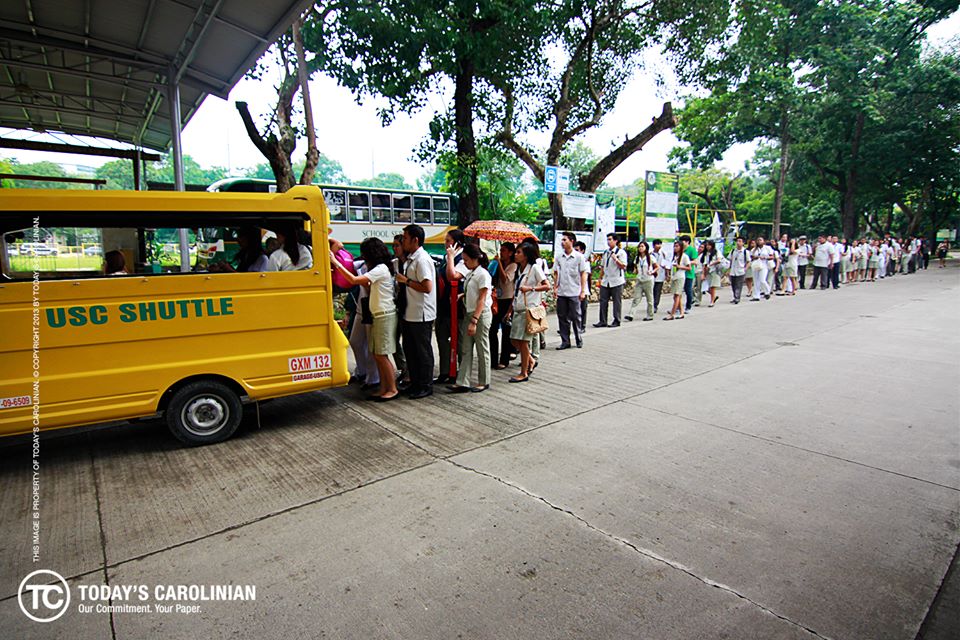
In an interview of one of the shuttle drivers, Mr. Gilbert Romeo says “Normally, the lines are long especially during peak hours – around 7:30 AM to 9:00 AM and 12:30 PM to 1:30 PM. During these hours, many students opt to use the shuttle service so as not to be late for classes.” Mr. Luigi Luche, also one of the drivers, adds “Fr. Eleno Bucia, SVD, the Vice President for Administration, ordered that we could go more than the speed limit if possible so the students would not be late for class. But we always make sure that we drive safely.”
Two freshmen AB Applied Linguistics—Sun Young Choi and Melanie Cuenco—say that they don’t mind lining up for the shuttle because they find difficulty in having to walk from the Portal to the CAS building. John Mendoza, a Pharmacy student, says he doesn’t mind lining up when he knows he has enough time. Still, there are students who do not mind walking around the campus to get to their next class. Shiela Burgos, a Chemical Engineering student, says that waiting for about 3 to 5 minutes for the Shuttle would somehow be a waste of time. She says that she’d rather walk if the building were near; that way, she could save 5 pesos. Some of the students believe that the long lines affect their academics. Zyla Redula, a Philosophy major, says that she gets impatient while lining up. She adds that she could have done something more productive like making assignments or studying for the time she uses to line up. She adds that she has experienced lining up for 10 minutes and that she’d missed out on her teacher’s discussion. Pete Tongco, an ICT freshman, has the same sentiments. Due to tardiness, students find it hard to catch up with the lessons being discussed by their teachers and a nuisance for those who work.
“Stress, usik ug oras, makagubag adlaw nya kapoy barog ug 10 minutes. (It’s stressful and such a waste of time. It ruins my day. It’s so tiring to stand for 10 minutes) adds Richard Honoridez (BS-ID, CAFA).
“As a working student, ma late kog samot. Di ko ka-panso on time, maka impatient labi nag naay mu overtake for about 5-10 minutes” says Zerrah Mancio BS MA of SBE
Previously, a shuttle’s trip to and fro would take three minutes on average. Now, the trip would take as long as six minutes. The number of trips they take for a day compared to the previous year decreased because of the many delays they encounter. Majority of the drivers blame the ongoing construction for the delay in transportation service. However, despite the delay, they see that the ongoing construction is for the development of the university. Redevelopments of some areas affect the usual travel time due to the change in routes. However, there are those who believe that, aside from the ongoing construction, the problem does not directly lie in the number of shuttles but rather on the students themselves. Mr. Luche, one of the drivers, commented, “It is not entirely our fault why the lines are always long; because, the drivers always try their best to fetch as many students as possible. Basically, the shuttle is a student’s last resort so they won’t be late for class thus explaining the long queue of students lining up.” He says further that it’s just a matter of the students’ discipline and responsibility. There are students who are too lax and who often have no regard for time. There are also students who have become very dependent on the 15 minute allowance provided by their teachers which prompts them to usually come to school just minutes before their classes start rather than arriving earlier.
The number of shuttles, time element, the number of students, the work habits of the students, and the on-going route that the shuttle drivers need to abide, are all factors that affect the long lines that await us when we enter the university.
Fr. Eleno Bucia, Vice President for Administration, says that the shuttles are managed by a cooperative and are not directly under USC. He says that the 12 shuttle drivers are actually husbands of some of the employees in the university. He adds that the he has asked the drivers to do their best to keep the lines short and gives four reasons as to why lines are long:
1. The route has become longer. Since the road near the Church of Sts. Arnold and Joseph has been closed (the road between CAFA and Bunzel), the shuttles have to pass through the access road from the Chapel to the Philip van Engelen – Science Building area and back to the Portal area. The trip to the Learning Resource Center (LRC), upon request of a passenger, can also delay the return of the shuttle back to the waiting area.
2. The on-going construction. the roads have not been paved and fixed as of the moment since construction and developments are still happening and contribute to the difficulty in traveling.
3. Other vehicles present that cause traffic.
4. Picky students – this happens especially when students travel in groups and do not want to separately travel. A shuttle driver waits until the shuttle is full before he leaves but this does not happen fast with students refusing to get in the shuttle that only has a few seats left.