

Standing in Victory
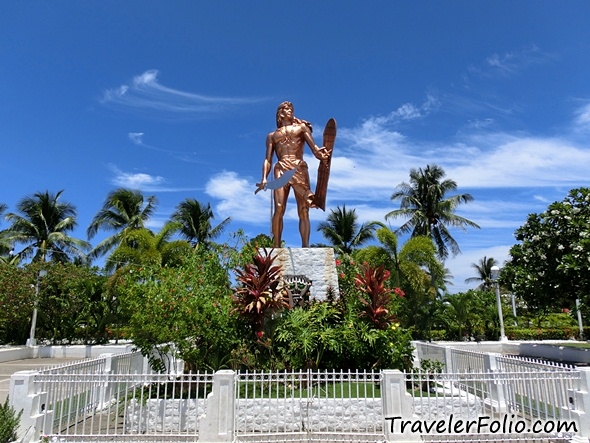
On an island east of mainland Cebu are a bold collection of sculptures. One boasts the bravery of the first Filipino hero – of the man whose image dwells on the obsolete one centavo coin – and the others honor the tragic end of the expedition of a foreign explorer. Found on the shores of Mactan Island is the historical Mactan Shrine, a complex in Barangay Mactan, Lapu-Lapu City where the Magellan Monument, the Magellan Marker and the Datu Lapu-Lapu Statue are located.
This area was the field for the famous Battle of Mactan that took place almost five centuries ago. This battle on April 27, 1521 is the earliest organized resistance of the Filipinos against foreign aggressors.
Its history started with Magellan’s voyage to realize Christopher Columbus’ plan to establish a spice route from Spain to the Asian kingdoms without spoiling the hazy relation of Spain and Portugal. It was a journey to the west, passing through the Pacific. On March 16, 1521, the silhouette of the Samar mountains were sighted by Magellan’s fleet, and on the subsequent day, they were able to anchor on the Philippine shores of Homonhon Island and then on the island of Limasawa, where the rajahs of these islands were welcoming to Magellan and his men.
On April 7, 1521, the Spanish expedition reached Cebu. Rajah Humabon of Cebu openly welcomed Magellan’s influences and allowed himself, his wife, and his people to be baptized as Christians. Thus, Catholicism was born on the island. As a symbol of Magellan’s conquest of Cebu, the Magellan’s cross was erected.
While the rajahs and most of the early Filipinos gave tribute to Magellan’s arrival on the islands and had embraced Christianity, Datu Lapu-Lapu of the adjacent island of Mactan refused to recognize Magellan’s authority. This angered Magellan who viewed Lapu-Lapu’s opposition as a direct disrespect to Spain. This became the budding of the Battle of Mactan.
In the accounts of Antonio Pigafetta, an Italian historian who served as Magellan’s assistant and who kept a close journal of the expedition, on the night prior to the battle, Magellan tried to convince Lapu-Lapu to comply with Humabon’s orders of providing food for the fleet and of Lapu-Lapu’s conversion to Christianity. The continued resistance of Lapu-Lapu brought the bludgeoning battle on the waters of Mactan, the turning of blue to blood red and ultimately, the death of Ferdinand Magellan in the hands of early Filipino fighters.
As the Philippines fell in the clutches of Spain years after the battle, the Magellan Monument was built in 1866 during the administration of Augustinian priest Simon Aguirre, who was cura of the Mactan Island, then called Opon. The monument is an obelisk on a base of several levels; becoming a memorial tower erected in honor of the fallen Portuguese explorer. It stands 30 feet tall, making it an apparent landmark inside the Mactan Shrine upon entrance. One side of the monument encrypts Ferdinand Magellan’s name in Portuguese: “Fernão de Magalhães”. Another side has the a dedication to the “Spanish glory”. The names Don Miguel Creuz, the Spanish governor of the Philippines upon the monument’s establishment, and Queen Ysabel II, the Spanish monarch of the same period, can be found on the remaining sides of the monument.
“On this spot Ferdinand Magellan died on April 27, 1521, wounded in an encounter with the soldiers of Lapu-Lapu, chief of Mactan Island. One of Magellan’s ships the Victoria under the command of Juan Sebastian Elcano sailed from Cebu on May 1, 1521, and anchored at San Lucar de Barrameda on September 6, 1522, thus completing the first circumnavigation of the earth.”These are the exact words encrypted on the Magellan Marker found a few steps away from the monument. The marker is shaped like a large headstone and is believed to be the exact spot where Magellan had died in the battle.
The monument and the marker stand as evidences that despite the common regard of Magellan as an enemy to the nation, he is still honored as the man who brought Christianity to the Philippines and who spearheaded the circumnavigation of the earth.
The Mactan Shrine also houses the statue celebrating the heroism of Datu Lapu-Lapu. His bronze monument faces the shore in a 66-feet stature. The statue shows Datu Lapu-Lapu holding a shield in one hand and a largebolo on another. This depiction is parallel to what is believed to be the exact weapon that the datu had actually used during the Battle of Mactan.
To commemorate Datu Lapu-Lapu’s victory in the historical battle, an annual Kadaugan sa Mactan celebration is held every April. The battle is re-enacted on the same shore where the real one took place. For years, the main roles of Datu Lapu-Lapu, Ferdinand Magellan and Reyna Bulakna – the wife of Datu Lapu-Lapu – are played by several prominent actors, actresses and beauty queens in the Philippine showbiz industry. A recent addition to the Kadaugan celebration is a street dancing competition endearingly called Rampada, a street party and a beauty pageant as a search for a Reyna Bulakna along the streets of Manuel L. Quezon Highway.
In line with the island’s yearly tradition, steps have been made to declare the commemoration of the Battle and Victory of Mactan as a national holiday. A bill has been filed in the Senate to declare April 27 as “Adlaw ni Lapu-Lapu” or “Lapu-Lapu Day”. The Lapu-Lapu City Representative Aileen Radaza has also filed a bill to the House or Representatives declaring the same day as a city holiday. An online petition gathering supporters to pass the bill is being hosted by www.change.org. The full petition link can be seen at the bottom of the article.
Now, Mactan Shrine stands not only as a showcase of the island’s colorful history, but also as a reminder of the clash between two different men who had forever carved their life stories on the same pebbled ground of the Mactan coast, and in effect, changed the lives of those who come after them – of Magellan who died for the glory of his King and of Lapu-Lapu who fought for his liberty.



















Thanks for helping me to see things in a difefrent light.