“Tukar” Concludes TEDxUSCSalon
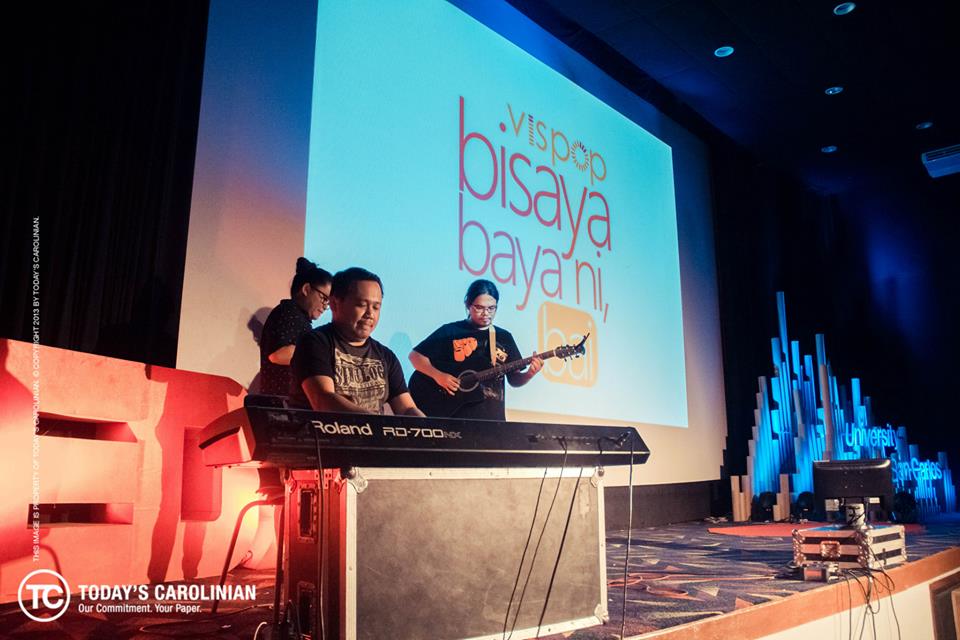
TEDxUSCSalon ended with its third and last session, “Tukar”, last Saturday in the CAFA Theatre with theme, “Response_Ability”. This TEDx event was hosted by Alem Garcia and Roy Racaza which was also participated by Carolinians and a number of Josenians.
Organized by the TEDxUSC, TEDxUSCSalon featured an independently-organized three-part event held every Saturday from February 14-28. Different from the previous TEDx events, TEDxUSCSalon exhibited diversity of topics and active audience engagement through sharing of insights from the series of talks.
“Buhay”, the first session, staged first tackling about life and philosophy. It was followed by the second session, “Konsepto”, which showcased technology and design. And the third, “Tukar” highlighted music.
Errol “Budoy” Marabiles was the first speaker for this session. He is the lead vocalist of the Cebu-based band, Junior Kilat. He was the person behind the hit songs, “Original Sigbin”, “Buwad Suka Sili” and “Ako si M-16” which bested Manila-based bands in the NU Rocks Best Song Award in 2005.
In his talk, he briefly took on the influence of “siday” on him. He said siday (poems) were sent in radio stations for contests in 1930s. These siday senders were the bloggers and newscasters alike in the present. Concluding his short talk, Budoy asked the audience’s participation in his sample of siday with the rhythmic claps by the participants.
Second to speak was Kaloy Uypuanco, a former manager of the OPM band, Urbandub and a part-time teacher at the University of San Jose – Recoletos. He talked about “Know Your (OP)Music.” He said environment is very important in shaping up one’s music culture.
“The lowest form of poverty is not one without food, not one without shelter. It’s losing your own identity,” he said. However, our local TV shows prefer to use foreign stuff.
On the other hand, he stressed that patronizing our own musicians concerns the community. He challenged the youth, as the last generation, to feel the effects of our dying music to do something about it before it dies.
The third speaker was Cattski Espina, a singer-songwriter, musician, entrepreneur, a record-producer and CEO of 22 Tango Records. She talked about “#homegrownmusic.” Espina pointed out that the mass media is doing a poor job in enhancing and preserving our very own music culture. She set the mainstream radio station as an example where foreign songs are mostly played than the local ones.
“Our homegrown songs are actually homeless,” Espina stressed out. She urged the young to let these local talents grow within them.
She also introduced the idea of “#SHHHHPOLICY” where audience keeps their voices down when an artist performs onstage. According to her, this is to give respect and value to the song and the artist. She ended singing her single in #SHHHHPOLICY.
Moreover, the fourth talk of the session, “The Hands that Help You Listen,” was presented by Jad Bantug, a music engineer, arranger, producer and owner of 1032 Recording Studio. Bantug exemplify his talk in the importance of sounds.
“I made more sounds that are more felt rather than heard,” he said. He played songs he arranged for Vispop 2.0 and some others.
For the last talk, “VisPop” was presented by a multi-awarded songwriter and musical director, Jude Gitamondoc. He has bagged several top placements in various songwriting contests. One was prestigious Cebu Popular Music Festival where he garnered a grand and second prize in a night for songs, “Pasaylo-a Ko” and “Bisan Pa”. He also wrote songs for Gary Valenciano, Nina, Piolo Pascual and more.
“OPM is not just Tagalog songs and that’s when VisPop came to mind.” In his talk, he discussed how essential Visayan music is, that it isn’t “kinaraan”, “bakya,” nor “bastos”. As Jim Paredes said, the only way to go global is to go local but sadly, Cebuanos or even Filipinos are not proud of themselves thinking that our local talents aren’t good enough for our taste.
“We need to reclaim and relearn our language.” Gitamondoc disclosed. He addressed this to the young audience to practically learn new Cebuano words so no one would anymore say, “Bisaya oy!” Hence, he’s hopeful that VisPop will pave the way for the propagation of Bisaya culture – OPM.
Afterwards, Espina, Bantug and Gitamondoc wrapped up “Tukar” with a surprise performance of “Usa ka Libo, ug usa ka Panamili” and a song by Espina herself. The three received a standing ovation from the performance and their respective talks.
Videos from other TED talks abroad were shown in between the session’s talks. First was “How Schools Kill Creativity” by Ken Robinson which surfaced education as a cause of depriving the natural creativity among students. “How Sampling Transformed Music” by Mark Ronson was viewed which dwell on the creation of some music of today out from a combination of samples from different songs.
Bisdak Pride Theater Group presented a short play about some social issues pertaining to the youth of today such as overcoming calamities, cheating, early pregnancy and the like. “Tukar” ended with the presentation of certificates to the five speakers and a photo opportunity with them.