

Colon Street
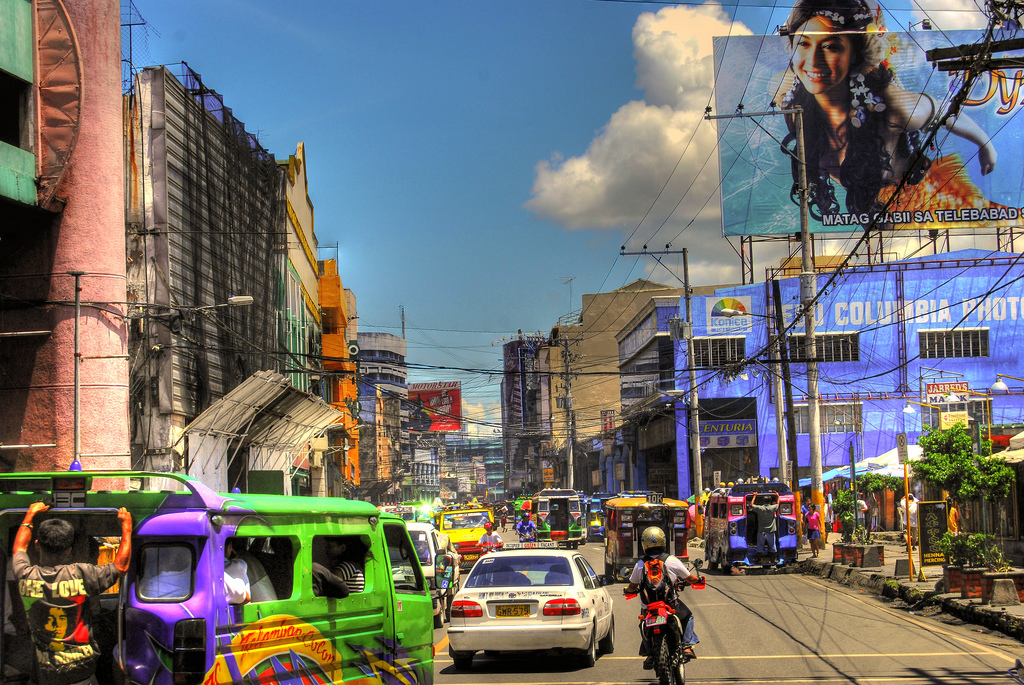 image source: https://www.flickr.com/photos/docjabagat/2624869036/
During early Spanish settlement in 1565, Spanish conqueror Miguel Lopez de Legazpi ordered the construction of Colon Street as part of St. Michael’s town. The street was named after the explorer Christopher Columbus, who is famous for his discovery of the “New World”, sailing for the Spanish monarchy despite his Italian origin. His name translates in Spanish to Cristobal Colon, hence the name of the street.
Since then, Colon Street has flourished to become one of the well-known residential streets in Cebu City. Most of its residents were descendants of prominent families in Cebuano society. Among its first settlements is Parian. According to Concepcion Briones, a pioneer of the Cultural & Historical Affairs Commission of the Cebu City Government, Parian was organized by the Spanish inquisitors in the Philippines with its houses built in a row, facing each other, on both sides of Colon Street. In his other account, Briones described Parian’s old houses to have a dignity of their own. The ancestral homes were made of limestone blocks, enormous molave posts and walls, and attractive red-tile roofs, with sliding windows of sturdy wooden frames and pretty lampirong or capiz panes.
Walking through the street, one would never fail to notice the Azoteas: traditionally a flat roof or platform on top of a house or another building. In Colon, however, Azoteas were open porches usually found on the second floor. Adelaida Javier, who used to be a resident of Colon, narrated how they used to have large Azoteas filled with birds, an aquarium for fish and other intricate decorations. It served as a place of leisure and recreation for the residents and their guests. Usually, a small garden is built and sometimes, it would also be used for laundry to dry various clothing. Even more so, Briones mentioned that anyone who grew up there could not possibly forget the sweet-scented gardens with flowering bush-lined pathways everywhere.Today, no trace of such beautiful thriving community is left. Instead, ruins of old buildings and theaters have replaced the sophisticated stone houses that used to line Colon’s corridors. The once sweet-scented gardens were run down by small-scale business establishments. Now, almost anything is bought and sold in the streets — such as apparel, shoes, DVDs, gadgets: whatever it is, we can find it here.. In the present, no longer are the infrastructures arrayed properly. The pleasant fragrance of flowers that once wafted through the noses of the passersby was now transformed into a mixture of the pungent odor of canals and the belched smoke from tiny food stalls and passing vehicles. Colon has morphed from a quiet rural settlement to a modern, larger and diverse commercial and business hub.
As much as many aspects have changed, trade is not a recent activity within Colon Street. In 1960, Cebuano Folklorist Jovito Abellana disproved the nonexistence of trade in Colon’s Parian prior to Spanish inquisition. Since the marketplace was bounded by the Parian and Tinago esteros that were navigable before sampans or flat-bottomed boats loaded with different merchandise were able to flow up to the vicinity of the Oriente Theater, which still stands in Colon today. After the arrival of de Legazpi, the community continued to live through trade, with porcelain as its most popular product. Its most popular product was porcelain. Eventually the trade died down due to the galleon trade in Manila. The effect of such a development did not only spread in Colon, but throughout Cebu as well. The population decreased because most Spanish and Cebuano residents moved to Manila.
In later times, Cebu began operating on trade again. Since the Spanish colonial government wanted to improve commercial and agricultural aspects of the country, Cebu became an “emporium” of products from Visayas and Mindanao. William D. Boyce, the founder of the Boy Scouts of America who also happened to be a journalist, wrote in US Colonies and Dependencies, “In Cebu, the old and the new are blended in a bewildering fashion. A modern concrete warehouse jostles a hoary vine-hung old convent; a big steamship from Manila docks beside a native’s bamboo banca; a noisy automobile tears past a wooden-wheeled carabao cart. All is life and bustle here, in the second city of the Philippines, where the people are more concerned with the shipment of hemp, copra, and sugar than with the historic associations which encircle their town and island.”
The economic decline during the Spanish colonization made the people focus more on their business developments. The countless stores currently crowding Colon Street is evidence of how greater importance is placed upon economic growth rather than historical appreciation. The Women International League (WIL) —Hapsay Sugbo Foundation Inc. aims to restore the memory of the historic beauty of Colon. WIL has already set up 32 heritage markers on some points of Colon Street. These heritage markers serve as a reminder of where historical structures formerly stood. Now, Colon Street was recognized by the National Historical Institute as a historical landmark in 1999. Being the oldest and shortest National road in the Philippines, it served an important role in economic development. The restoration and preservation of its historic role in the lives of Cebuanos should be every Cebuanos’ responsibility.














1 Response
[…] https://todayscarolinian.net/2015/04/20/colon-street/ […]