Forgetting Huwebes Santo
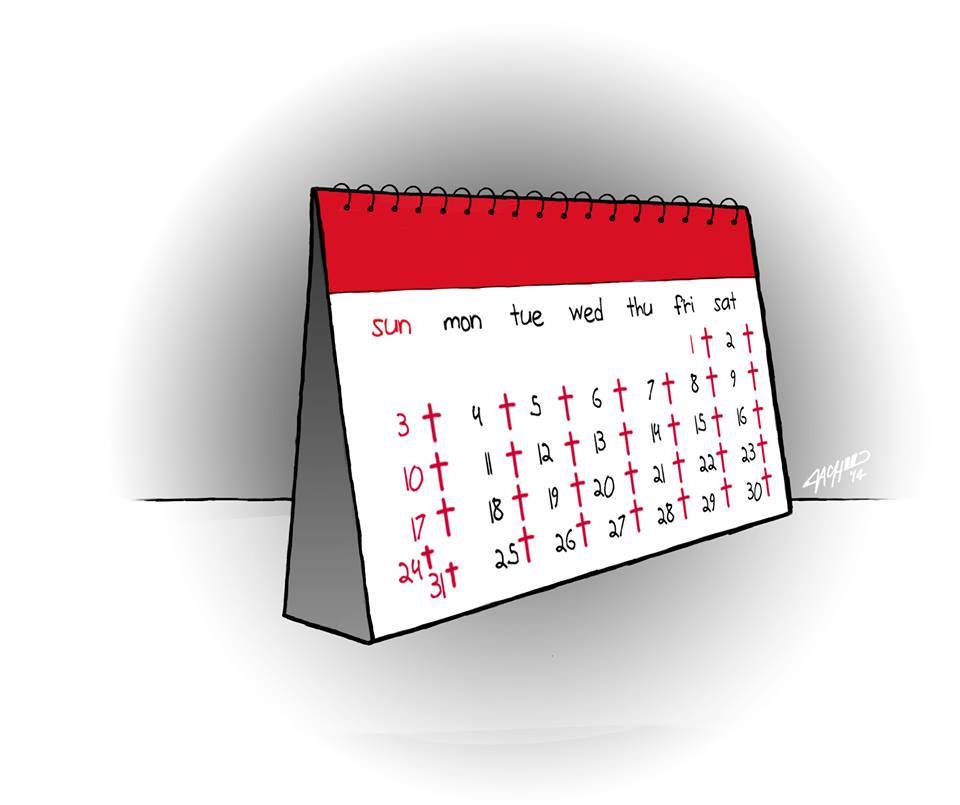
Huwebes Santo is a day when the Church puts aside all of its mourning. The cross is veiled in white, and the altar is brightly decorated. Everyone rejoices for the institution of the Holy Eucharist at the Last Supper. However, most of us will probably never know that as we are far too preoccupied with our summer plans to remember that the Maundy Thursday Mass starts at 4:00 a.m.
Most of us probably know the story of how we had somehow overslept last year or how we were probably ‘inconveniently’ sick the year before that but this year let us enlighten ourselves of what we will be missing and of what we might not know about this day.
For starters, today is a holiday. No, it is not because on summer vacation everyday is a holiday but because Republic Act No. 9492 Sec. 26, otherwise known as An Act Rationalizing the Celebration of National Holidays, lists Huwebes Santo as an observed regular holiday and because Presidential Proclamation 655 which declares the regular holidays, special (non-working) holidays, and special holiday (for all schools) for the year 2014 has declared it as a holiday. The big idea behind Huwebes Santo being a holiday is that establishments are expected to lock the front door and raise the red lines. There will be no such thing as mall-hopping for this day.
Another thing, Huwebes Santomarks the beginning of the Easter Triduum. The Easter Triduum, Three Days or Paschal Triduum is a celebration of Christ’s passion, death and resurrection and is considered to be the most important time of the church year. The celebration commences with the Maundy Thursday’s Mass of the Lord’s Supper and continues throughout Good Friday and Black Saturday with the celebration of the Passion of the Lord and climaxes and ends on Sunday’s Easter Vigil. As Fr. Jun Mercado Omi describes, “Paschal Triduum is the very core of our Christian faith, proclamation and witnessing. It is a celebration very much akin to ‘three-in-one’ coffee. They all go together, and we cannot be choosy which one to attend and which one to miss.”Today, the Chrism Mass is celebrated. This morning, as we were so aptly snoring on our beds, the priests, deacons, and representatives of the entire diocesan community have already gathered with their bishop to celebrate this Holy Mass. As we continued to put our alarm clocks on snooze, the bishop has blessed the three oils that will be used in the administration of the sacraments in the diocese year. The oil of catechumens will be for the adult catechumens and infants; catechumens are new converts to Christianity who are being taught the principles of Christianity by a catechist. There is also the oil of the sick will be used in anointing the sick and the holy oil of chrism that will be for the sacraments of baptism, confirmation, the ordination of the priest and the consecration of altars. All three are basically olive oils. For pastoral reasons, however, another vegetable oil and perfume maybe used.
Later on, the assembly will have renewed their baptismal promises, their vows of obedience to the bishop, and their continuous commitment to serve God’s people while we try to pretend that the sunlight hasn’t been glaring past our windows in the last hour. By the time we finally decide to drag ourselves out of bed, we might as well thank ourselves for deciding not to have taken the path of the clergyman. In such cases, we have already missed one of the most important and solemn liturgies of the church; that is, if we actually passed the trials of priesthood. Our priests become actors who will most probably be the Jesus’ washing his apostles’ feet. However, for us to see it, we must first admit ourselves to the Holy Mass wherein the washing of feet is a part of.
Given that we did wake up early and that we did pay attention to the service, we would be able to notice the emphasis on three aspects of the Mass: the Institution of the Eucharist, the Institution of Priesthood, and Christ’s command for brotherly love. As customary, the bells will be rung during the singing of the ‘Gloria’ but are to remain silent until the same song on the Easter Vigil. The highlight today will be the re-enactment of Jesus’ washing of his apostles’ feet; the only reason why you might have wanted to attend church. On a more serious note, this represents the service and charity of Christ who came not to be served but to serve.
Jesus gave a new commandment on this day, several hundred years ago. Ever wondered why Maundy tags along with today’s Thursday? Maundy – not to be mistaken with Monday as that would confuse children – is derived from the Latin word ‘mandatum’ which can be translated as ‘commandment’ in living language. What exactly is its significance? It was in this day that Christ told his disciples, “A new commandment I give you: love one another as I have loved you.”(Jn 13:34)
However, as we log in our social media accounts, people may have already flooded our newsfeeds with all their selfies with the different churches and cathedrals they’ve visited. Let us brace ourselves! But today’s technology and people makesthis hardly unexpected. Many of us will start doing our Visita Iglesia.
For the record, Visita Iglesia is a Spanish term that means “the church visit”. It is an age-old tradition which traces back to the Apostolic Age that has become a devout Roman Catholic Lenten custom in which Christians are encouraged to visit seven churches or religious sites. The general practice during these visits is to recite the Stations of the Cross while in the vicinity. The religious few often go for fourteen churches while the elderly visit one. However, it was during the 1970s that people begun to recite all fourteen stations in one church. Since the Philippines is a home of such religious people, it will not be much of a surprise to see some devout to carry a cross from one church to another. But today is a test of how much of a Catholic we really are. Really, we should have taken some time to shower, go to mass, and visited churches.