Guarding the Goliaths
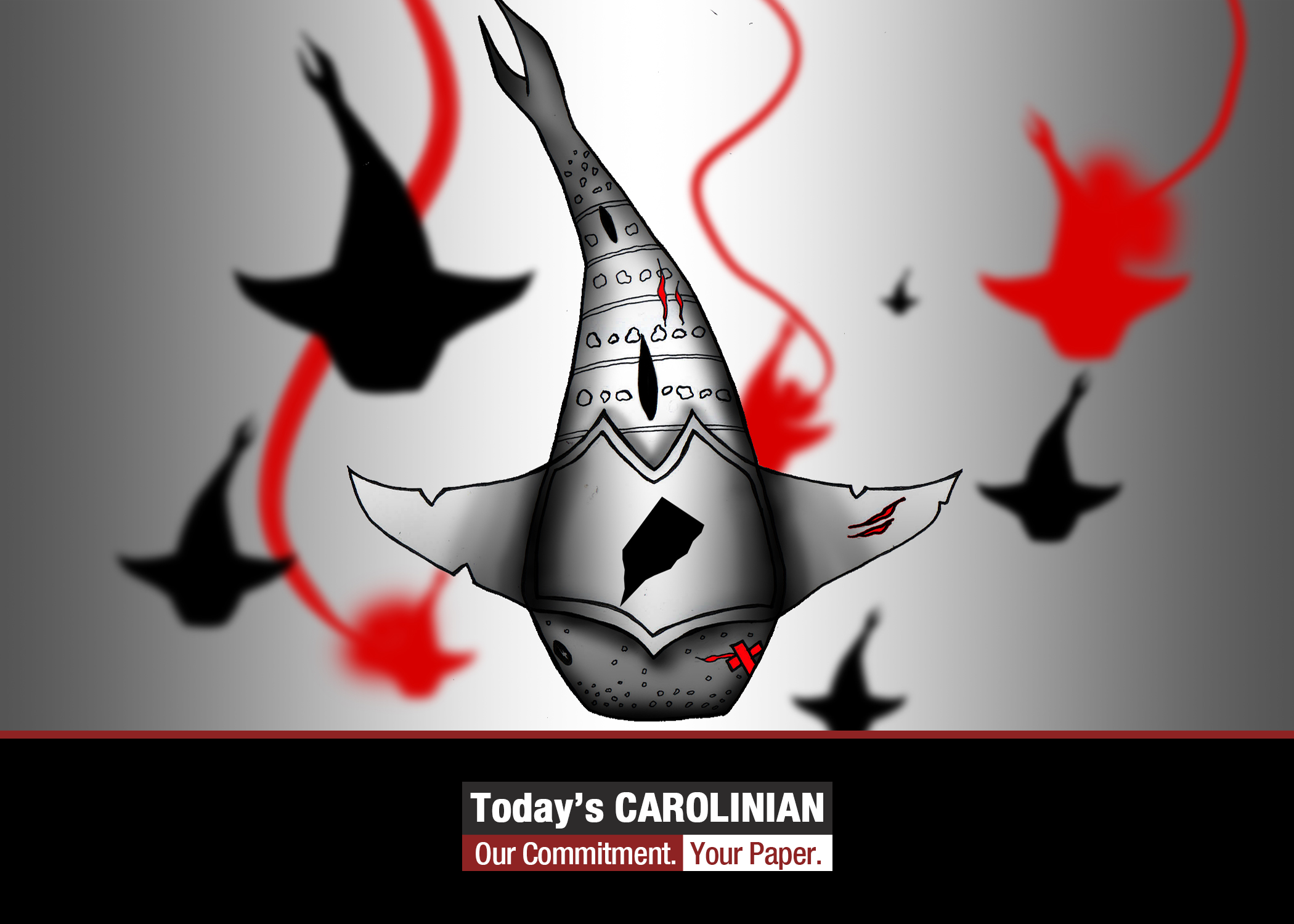
Illustration by Mar Virgil Eway
It is hard to hear the word “Oslob” and not think of its biggest attraction — literally. Formerly just another small municipality at Cebu’s south end, the town’s popularity exploded overnight thanks to local wildlife tourism; namely, its now-ubiquitous whale shark watching tours, which draw throngs of tourists year-round. It is nothing but good news for the town and its people, but unfortunately, the same cannot be said for the sharks.
Whale sharks are the largest fish in the ocean, bar none. Seen from the front, their comically-wide mouths swing open and shut in search of plankton and algae to feed on, punctuated at each end by a round, beady eye. When observed from above, however, it is a different beast altogether. Its simple-looking face ends, then the rest of its body begins, and it becomes clear that the whale shark is a marvelously-engineered creature. Its gills pump methodically and purposefully while its body undulates as it moves through the water, a single wave of motion traveling down the shark’s body until it culminates in a flick of the tail fin, described by Jaws author Peter Benchley as “hard as iron”. The whale shark’s body is a mellow blue-gray color, speckled with white spots and broken lines. With its crossbow shape and unflinching, deliberate movements, it projects the no-nonsense, imperial attitude of its fellow sharks —without having to bare a single tooth.
The whale sharks of Oslob are no exceptions to this rule, and it is very easy to see why so many people flock to their waters to see them day in and day out. Like their cousins, the similarly-enormous manta rays, they are completely harmless to humans, thanks to their inefficient teeth and throats as big around as a softball. In fact, many researchers have described them — especially the younglings, only a few meters in length — as possessing childlike inquisitiveness toward scuba divers. Perhaps that is why it did not take long for it to become commonplace in Oslob to dump uyap — tiny shrimp, almost indistinguishable from one another — into the water until a curious shark comes near. Seeing them hungrily gulping up shrimp brings to mind the image of an oversized koi — and that is exactly where the problem lies.
Whale sharks are not koi. They are not domesticated, or even tamed, animals in the slightest. We do not know how they reproduce, let alone how to breed them. There is too much that we do not know about these animals to risk altering the way of life they have been perfecting since before we so much as set foot in the ocean. We do, however, know this: conditioning any animal to be dependent on humans is unnatural. We have learnt this from everything from squirrels to seagulls to bears, and there is no reason it should not apply to whale sharks. It is Pavlovian conditioning, plain and simple: the animal associates the presence of humans with the presence of food. Then, with those needs met, the whale shark, a migratory animal by nature, has no need to migrate when food is available abundantly, and more importantly, right on schedule.
Why is that important? Scientists still do not know the exact reason, and perhaps they will not find out for a long while. However, the whale shark is not just a part of the ecosystem of Oslob; it is a part of wherever the current takes it, and for one wild shark, that could mean thousands of square miles of ocean, far beyond the reaches of Cebu or even the Philippines; for a conditioned, well-fed shark, that could be restricted to a few hundred miles, if that. The world is like a thousand million games of Jenga all being played at the same time. Take out a block, and the tower might fall; and with a maximum length of forty feet, the whale shark is a very, very large block indeed. Is removing that block really a chance we want to take? Perhaps it’s nothing but speculation. Still, as Aldo Leopold once said, “Who but a fool would discard seemingly useless parts?”
Additionally, the evidence is mounting that, as the number of tourists grows, so does the amount of stress the animals are subject to. Normally pelagic, open-sea dwellers, the whale sharks are being coaxed into waters shallower than they are long, all for the promise of an easy meal. What happens when they run into a vessel that is not carrying a bucketful of shrimp? Ask “Fermin”, one of Oslob’s resident whale sharks, whose face came too close to a boat propeller — something totally out of the question for most whale sharks — and is now sporting a blind left eye and a collection of scars. Worse yet, what happens if an eager shark approaches a vessel expecting a handout, only for it to be staffed by poachers? That may be an “if”, but if at all possible, it is an “if” we should not have to think about.
Although the whale shark tours have their flaws, they are far from immoral; they’re a mark of innovation, of a community using its resources for the benefit of everyone involved. Eco-tourism is built around a single principle: sustainability. The idea to work toward is to create a lasting resource for the community that destroys nothing and builds up everyone and everything involved. It is bringing money to people who need it. On the topic of money, take a look at a PHP 100 bill. It boasts the likeness of former president Manuel Roxas on one side, and on the other, a meticulously-rendered whale shark. It is no secret that they have become a national treasure, a celebration of the wealth of our country’s waters.
However, we need to do more than just celebrate the whale sharks: we need to protect them, to consider their stake in the matter just as much as we consider Oslob’s human residents. It is going to take time, cooperation, and compromise. All those words may sound nice on paper, but they are almost impossible to practice. Nonetheless, this is better than gambling the future of the same animals we have come to know, depend on and love.